Joseph Smith (1805–1844) is regarded by members of The Church of Jesus Christ of Latter-day Saints as the prophet of the Restoration.
From this perspective, he was not creating a new religion—but restoring ancient doctrines, priesthood authority, and temple worship believed to have been lost after the era of Christ’s Apostles.
Joseph Smith and Freemasonry
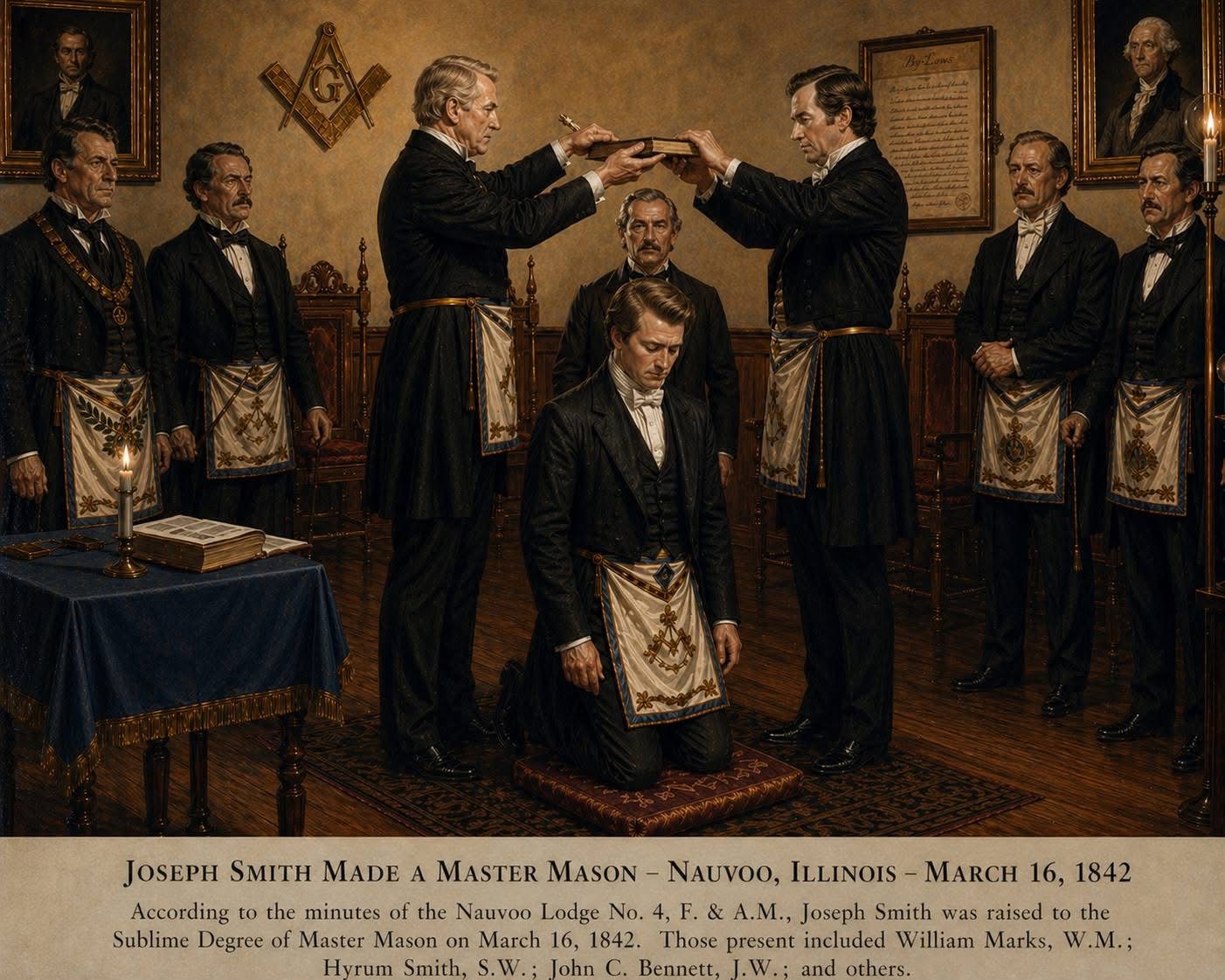
Joseph Smith became a member of Freemasonry in March 1842 in Nauvoo, Illinois. He joined alongside several close associates, including his brother Hyrum Smith.
At the time, Freemasonry functioned as a fraternal society that taught moral principles through symbolic rituals and allegory.
Within weeks of joining, Joseph introduced Latter-day Saint temple ordinances—something that has sparked ongoing discussion due to perceived similarities.
Latter-day Saint Viewpoint
Rather than seeing this as imitation, many Latter-day Saints interpret it differently:
- Freemasonry may have preserved fragments of ancient symbolic traditions.
- Joseph Smith, through revelation, restored their original divine meaning.
- His involvement is viewed as contextual—not foundational—to his prophetic role.
Family Connections to Masonry
Joseph Smith’s exposure to Masonic ideas likely did not begin in isolation:
- His brother Hyrum Smith was an active Mason.
- His father, Joseph Smith Sr., is believed to have had some level of Masonic familiarity.
- Several early Church leaders in Nauvoo were also involved in Masonry.
This environment may have provided familiarity with symbolic systems—but not the source of revelation itself.
Temple Worship vs. Masonic Ritual
This is the most discussed comparison.
Observed Similarities:
- Structured progression through stages
- Use of symbolic gestures and signs
- Sacred clothing (such as aprons and robes)
- Moral instruction tied to commitments
Key Differences:
Freemasonry
- Fraternal and symbolic
- Does not claim divine authority
- Focused on ethical teachings
Latter-day Saint Temple Worship
- Centers on sacred covenants tied to salvation
- Claimed to be revealed by God
- Teaches eternal progression and priesthood authority
Core Distinction:
Similarity in form does not imply shared origin.
Latter-day Saints believe Masonry reflects fragments—while temple worship represents a restored whole.
Biblical Connections
Freemasonry itself draws heavily from biblical imagery, especially from the building of Solomon’s Temple.
Common Themes:
- Progression toward divine presence
- Sacred knowledge revealed in stages
- Symbolism used to teach spiritual truths
- Covenant relationships with God
Shared Figures & Elements:
- King Solomon
- Temple architecture (pillars, altars, sacred spaces)
- Symbolic figures like Hiram Abiff
Latter-day Saint Interpretation
From an LDS perspective:
- The Bible preserves authentic patterns of ancient temple worship.
- Over time, these patterns were altered or partially preserved in traditions like Masonry.
So the framework becomes:
- Masonry → partial preservation
- LDS temple ordinances → restored system
Timeline of Joseph Smith’s Masonic Advancement
Joseph Smith progressed through Freemasonry rapidly:
- March 15, 1842 – Entered Apprentice
- March 16, 1842 – Fellow Craft
- March 16, 1842 – Master Mason
Completing all three degrees in roughly 24 hours is unusual by modern standards—but not unheard of in the 19th century.
Why So Fast?
Several historical factors explain this:
- Nauvoo’s rapid growth: The lodge was newly formed and expanding quickly.
- Leadership role: Joseph was the central civic and religious figure in the city.
- Period norms: Accelerated advancement occurred in frontier lodges when needed.
What Is a Master Mason?
In Freemasonry, becoming a Master Mason represents:
- Full membership in the lodge
- Completion of the core symbolic journey
- Participation in central teachings, including the allegory of Hiram Abiff
It emphasizes integrity, loyalty, and the pursuit of truth.
Putting It All Together
From a Latter-day Saint perspective:
- Joseph Smith’s teachings did not originate from Freemasonry.
- His prophetic role was established years before his Masonic involvement.
- Masonry may have provided symbolic language—but not doctrine.
Temple ordinances are understood as:
- Revealed, not invented
- Ancient in origin, not modern creations
Bottom Line
- Joseph Smith joined Freemasonry in March 1842 and advanced rapidly within days.
- His involvement is viewed as historically contextual rather than doctrinally influential.
- Similarities between Masonry and temple worship are interpreted as shared ancient roots—not direct borrowing
No comments:
Post a Comment