Showing posts with label Public Service. Show all posts

Friday, July 24, 2026

Over 1,300 Cops Dismissed as PNP Intensifies Internal Cleanup

Over 1,300 Cops Dismissed as PNP Intensifies Internal Cleanup

Introduction

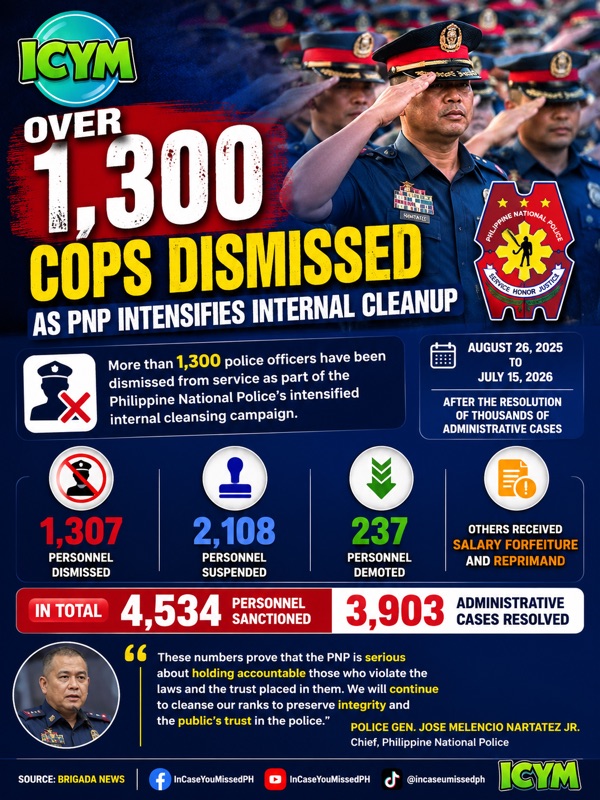
The Philippine National Police (PNP) has stepped up its internal cleansing campaign, resulting in the dismissal of more than 1,300 police officers found administratively liable. The latest figures underscore the organization’s effort to enforce accountability and strengthen public confidence in law enforcement.

Background

Maintaining discipline and integrity within the police force has long been a priority for the PNP. Through its internal affairs and administrative processes, officers accused of misconduct undergo investigations that may lead to disciplinary action if violations are proven.

From August 26, 2025, to July 15, 2026, the PNP resolved thousands of administrative cases involving its personnel, leading to a wide range of penalties.

The Internal Cleansing Drive

According to official PNP data:

  • 1,307 police personnel were dismissed from service.
  • 2,108 personnel were suspended.
  • 237 personnel were demoted.
  • Others received salary forfeiture and formal reprimands.

Overall, 4,534 personnel were sanctioned following the resolution of 3,903 administrative cases.

PNP Chief Police General Jose Melencio Nartatez Jr. said these numbers reflect the organization’s determination to remove erring personnel, enforce discipline, and ensure that those who violate the law and police regulations are held accountable.

Why This Matters

Public trust is one of the most valuable assets of any law enforcement agency. Every administrative case resolved demonstrates that misconduct within the ranks is being addressed through established disciplinary procedures.

An effective internal accountability system can:

  • Strengthen professionalism within the police force.
  • Deter future misconduct.
  • Improve public confidence in law enforcement.
  • Reinforce the principle that no officer is above the rules.

A Broader Perspective

While the dismissal of more than 1,300 officers is significant, the figures also highlight the scale of the challenge facing the PNP. Internal cleansing is an ongoing process that requires consistent enforcement, transparent investigations, and due process for all personnel involved.

Beyond disciplinary action, experts often point to continuous ethics training, leadership development, and institutional reforms as essential components of building a professional and trusted police organization.

Conclusion

The latest administrative actions taken by the Philippine National Police demonstrate an active effort to strengthen accountability within its ranks. Whether these measures translate into greater public confidence will depend not only on disciplinary actions but also on sustained reforms, transparency, and consistent enforcement of the law.

Your Thoughts

Do you believe the PNP’s intensified internal cleansing campaign will help restore public trust in the police? Share your views respectfully in the comments.

Mention:
@PhilippineNationalPolice

Hashtags:
#PNP #InternalCleansing #PoliceReform #Accountability #LawEnforcement #Philippines #GoodGovernance #PublicTrust #ICYM #InCaseYouMissed

Follow
Follow In Case You Missed (ICYM) for balanced updates on Philippine news, public affairs, and national issues.

Share your thoughts respectfully in the comments below.

Tuesday, July 21, 2026

IMPEACHMENT COURT IS NOT ICC: Escudero Corrects ICC Reference During Senate Trial

IMPEACHMENT COURT IS NOT ICC: Escudero Corrects ICC Reference During Senate Trial

Introduction

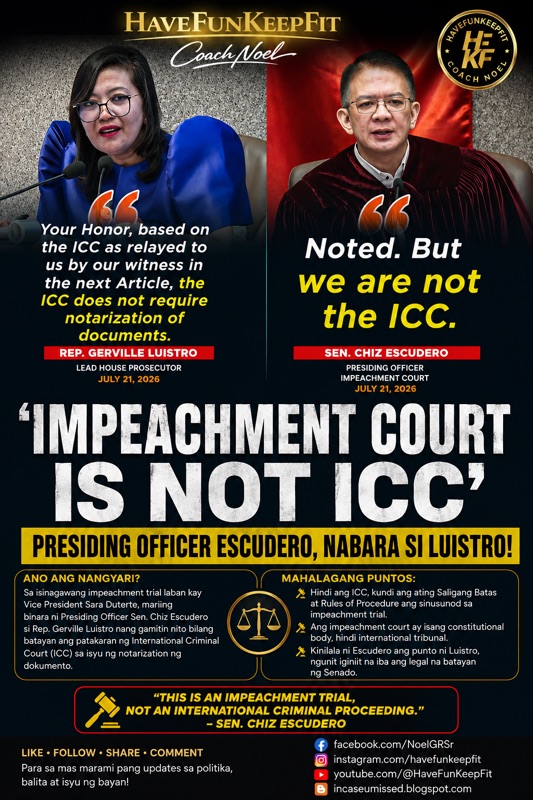
A brief but significant exchange during the Senate impeachment trial of Vice President Sara Duterte drew public attention after Presiding Officer Sen. Francis “Chiz” Escudero reminded the prosecution that the Philippine impeachment court is not the International Criminal Court (ICC).

The moment came after Lead House Prosecutor Rep. Gerville Luistro cited ICC practice regarding the notarization of documents. Escudero immediately responded:

“Noted. But we are not the ICC.”

The remark underscored the distinction between Philippine constitutional proceedings and international judicial processes.


Background

The Senate is currently convened as an impeachment court under the 1987 Philippine Constitution to hear the case against Vice President Sara Duterte.

Throughout the proceedings, both the prosecution and defense have presented legal arguments, documentary evidence, and witness testimonies. As with any impeachment trial, disputes over the admissibility and authentication of evidence are expected.

During one such discussion, the prosecution referred to ICC procedures, arguing that notarization of certain documents is not required under ICC rules.


The Investigation

In response, Presiding Officer Escudero clarified that while the prosecution’s observation was noted, the Senate impeachment court is governed by Philippine law—not by the procedural rules of the ICC.

His statement emphasized that:

  • The Senate impeachment court derives its authority from the 1987 Philippine Constitution.
  • Proceedings are governed by the Senate’s Rules of Procedure on Impeachment Trials.
  • International court procedures do not automatically apply to domestic constitutional proceedings.

The exchange became one of the notable moments of the day’s hearing, highlighting the importance of identifying the correct legal framework when presenting arguments before the impeachment court.


Why the Issue Matters

The discussion goes beyond a procedural disagreement.

It highlights a fundamental legal principle: different courts operate under different jurisdictions and procedural rules.

The ICC is an international tribunal created by the Rome Statute to prosecute crimes such as genocide, crimes against humanity, war crimes, and the crime of aggression.

The Philippine Senate, when sitting as an impeachment court, performs a constitutional function that is governed by Philippine law and the Constitution.

Understanding this distinction helps the public better appreciate why procedural rules cannot simply be transferred from one legal system to another.


Important Perspective

Legal proceedings are often shaped not only by facts but also by the rules that govern how evidence is presented and evaluated.

Whether one supports the prosecution or the defense, adherence to the applicable legal framework is essential to maintaining the credibility of the impeachment process.

Escudero’s reminder served as a procedural clarification rather than a ruling on the merits of the evidence itself. Ultimately, the admissibility and weight of evidence remain matters for the impeachment court to resolve under its own rules.


Conclusion

The exchange between Rep. Gerville Luistro and Presiding Officer Chiz Escudero highlighted the importance of applying the correct legal standards in constitutional proceedings.

As the impeachment trial continues, each side is expected to present arguments grounded in Philippine law, while the Senate impeachment court determines the issues based on the Constitution, Senate rules, and applicable jurisprudence.


Your Thoughts

Do you think Presiding Officer Escudero made the correct procedural clarification by reminding the prosecution that “the impeachment court is not the ICC”?

How important is it for legal arguments to remain within the proper constitutional framework during an impeachment trial?


Mention

Source: Senate Impeachment Trial Proceedings • July 21, 2026

Hashtags

#ImpeachmentTrial #SenateImpeachment #ChizEscudero #GervilleLuistro #PhilippinePolitics #RuleOfLaw #1987Constitution #LegalProcess #CurrentEvents #InCaseYouMissedPH

Follow

Follow InCaseYouMissedPH for updates, balanced political coverage, legal explainers, and breaking national news.

Share your thoughts respectfully in the comments below.

Thursday, July 16, 2026

Twin Investigations? Alan Peter Cayetano Calls for Simultaneous Action on DOJ-NBI Probe and Flood Control


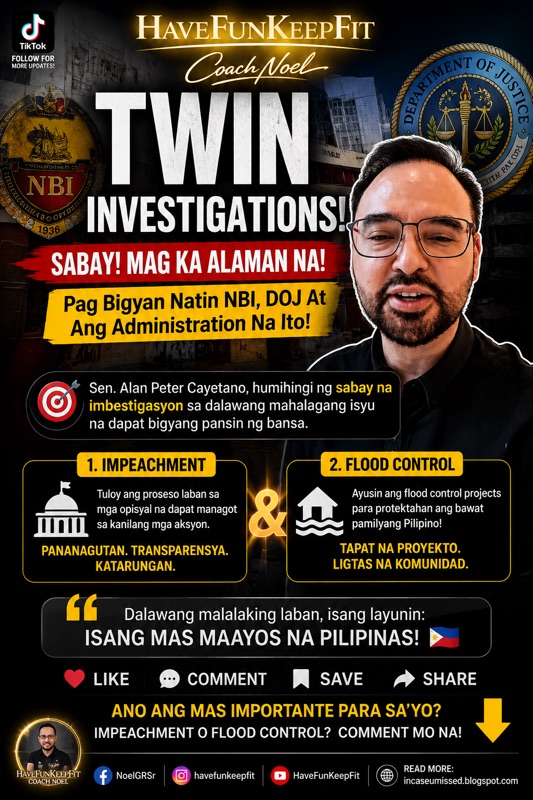
Senator Alan Peter Cayetano has sparked renewed public discussion after urging the government to pursue what he called “twin investigations.” In a recent live broadcast, Cayetano emphasized that the administration should not choose between pursuing accountability and addressing urgent public concerns. Instead, he argued that both can—and should—be handled at the same time.

His remarks come as the country closely follows the impeachment proceedings involving Vice President Sara Duterte while many communities continue to grapple with flooding caused by heavy rains.


The Call for Twin Priorities

During his live stream, Cayetano appealed to the administration, the Department of Justice (DOJ), and the National Bureau of Investigation (NBI) to continue their legal responsibilities while ensuring that flood control projects remain a top government priority.

His central message was straightforward:

The government should be capable of handling multiple critical issues simultaneously without neglecting either one.

The senator questioned why national attention should be limited to a single issue when public institutions are expected to perform several essential functions at the same time.


Two Major Issues at the Center of the Discussion

1. Accountability Through Investigation

Cayetano reiterated the importance of allowing government investigative agencies to perform their duties independently.

This includes:

  • Conducting investigations based on evidence.
  • Upholding due process.
  • Ensuring transparency and accountability.
  • Allowing legal institutions to determine responsibility where appropriate.

He suggested that pursuing justice should continue without unnecessary delays.


2. Flood Control and Public Safety

At the same time, Cayetano stressed that flood prevention projects deserve immediate attention.

Among the concerns frequently raised by local communities are:

  • Delayed infrastructure projects.
  • Clogged waterways and drainage systems.
  • Flood mitigation programs.
  • Disaster preparedness.
  • Protection of lives and property during the rainy season.

For many Filipinos, these issues directly affect their daily lives and cannot simply wait until political controversies have concluded.


Can Government Address Both at Once?

Cayetano’s proposal raises a broader governance question.

Should government agencies focus exclusively on one national issue at a time?

Or should different departments continue performing their respective responsibilities simultaneously?

Supporters argue that modern governments are designed precisely for this purpose. Different agencies have different mandates, budgets, and personnel, making it possible to investigate legal matters while continuing infrastructure development and disaster response.

Others maintain that major political events inevitably consume government attention and resources, potentially affecting other priorities.


Why the Discussion Matters

The Philippines regularly faces multiple national challenges at the same time—from political developments and legal proceedings to natural disasters and economic concerns.

Many citizens expect leaders not only to uphold the rule of law but also to ensure that essential public services continue uninterrupted.

The debate sparked by Cayetano reflects a broader public expectation: government should be capable of delivering justice while simultaneously protecting communities and improving public welfare.


A Balanced Perspective

Whether one agrees or disagrees with Senator Alan Peter Cayetano’s position, his remarks have contributed to an important national conversation about governance and public priorities.

The issues of legal accountability and flood control are not necessarily mutually exclusive. One concerns the rule of law, while the other concerns public safety and infrastructure. Both affect millions of Filipinos in different ways.

Ultimately, how government balances these responsibilities remains a matter for public discussion and policy decisions.


Conclusion

As the impeachment proceedings continue and flood-related concerns remain significant across the country, Filipinos will continue watching how government institutions respond to both challenges.


The discussion highlights an enduring question:

Can the government effectively pursue accountability while ensuring that urgent public services and disaster prevention efforts continue without interruption?

The answer may shape public expectations of governance in the months ahead.


Alan Peter Cayetano, Twin Investigations, DOJ, NBI, Flood Control, Philippine Politics, Impeachment, Government Accountability, Public Safety, Infrastructure Projects, Philippines News, Vice President Sara Duterte, Disaster Preparedness, Rule of Law, National Issues.