BEFORE QUESTIONING THE PRICE OF ACCOUNTABILITY, GET YOUR FACTS STRAIGHT!
When it comes to justice, accountability, and public funds, facts must come before political narratives.
The controversial claim that the impeachment proceedings against Vice President Sara Duterte cost taxpayers “₱975 million for a show without a finale” has sparked debate. But before accepting that figure as proof of government waste, one important question must be answered:
Are we talking about the actual cost of the impeachment proceedings—or the Senate’s regular operating expenses?
That distinction changes the entire argument.
THE ₱975-MILLION CLAIM: WHAT DO THE FIGURES REALLY SHOW?
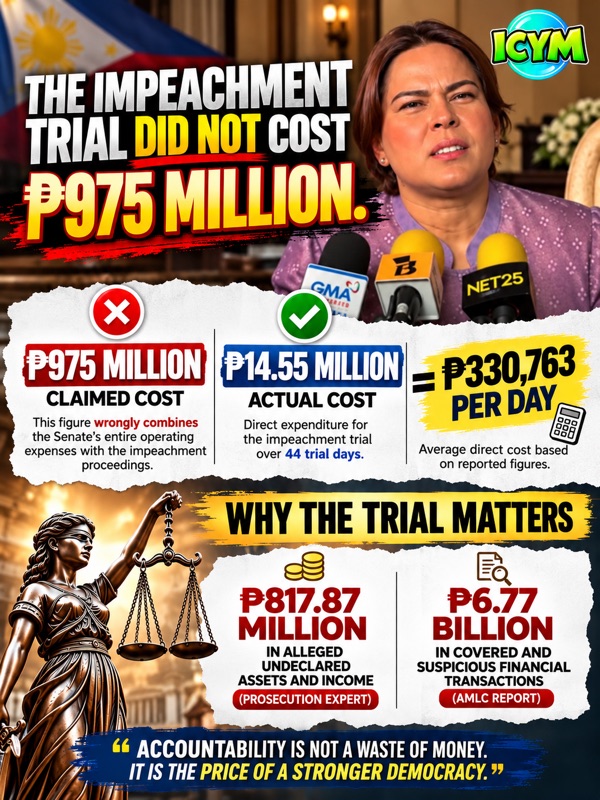
According to figures attributed to Senate President Win Gatchalian, the widely circulated ₱25-million daily amount refers to the Senate’s general operating expenses, including employee salaries, utilities, maintenance, and other institutional costs.
It does not represent money spent exclusively on the impeachment proceedings.
The figures cited in the debate indicate:
- ₱25 million per day – Reported regular Senate operating expenses.
- ₱14.55 million – Reported direct expenditure associated with the impeachment proceedings.
- 44 trial days – The period used in the reported cost calculation.
- Approximately ₱330,682 per day – Average direct expenditure based on those figures.
Gatchalian reportedly rejected the suggestion that the impeachment trial itself cost ₱25 million daily, while Explained PH was cited as having rated the ₱975-million claim false.
These reported figures and the fact-check’s precise findings should be verified against their original sources before publication.
The bottom line? Operating an entire legislative institution is not the same as paying for one constitutional proceeding.
Confusing the two risks turning a legitimate discussion about government spending into a misleading political narrative.
SINCE WHEN DID JUSTICE BECOME TOO EXPENSIVE?
Beyond the dispute over the numbers lies a far more important question:
Since when has the cost of pursuing accountability become a valid excuse to avoid it?
Justice has never been free.
Investigations require resources. Hearings require personnel. Evidence must be examined, witnesses heard, and constitutional procedures followed.
That is how democratic institutions are supposed to function.
We do not measure the value of justice simply by calculating how much money was spent or whether a proceeding produced the outcome certain political groups wanted.
Due process is not a television show. Accountability is not entertainment. And constitutional proceedings should not be judged solely by whether they deliver a dramatic finale.
THE ALLEGATIONS DESERVE ANSWERS, NOT POLITICAL DISTRACTIONS
The impeachment controversy involves no ordinary public official. It concerns the Vice President of the Republic of the Philippines—one of the country’s highest constitutional officers.
During the controversy, reports cited allegations involving substantial financial transactions and potentially unexplained wealth.
Among the figures circulated were:
₱817.87 million in alleged undeclared assets and income, reportedly identified by a prosecution expert.
₱6.77 billion in covered and suspicious financial transactions reportedly associated with Duterte and her husband, based on information attributed to the Anti-Money Laundering Council.
These figures represent reported allegations and financial information, not judicial findings of wrongdoing. Their accuracy, context, and evidentiary significance must be established through appropriate legal proceedings.
Vice President Duterte, like every Filipino citizen, is entitled to the presumption of innocence, a fair opportunity to respond, and full protection of her constitutional rights.
But due process works both ways.
The right to defend oneself does not eliminate the public’s right to demand transparency and lawful accountability.
PUBLIC OFFICE IS A PUBLIC TRUST—NOT A SHIELD AGAINST SCRUTINY
Ordinary Filipinos are expected to comply with the law, explain questionable transactions when legally required, and face investigations when sufficient grounds exist.
Why should the standards be any different for those occupying the highest positions in government?
Public office carries enormous responsibility. The greater the authority entrusted to an official, the greater the public interest in ensuring that power is exercised lawfully and transparently.
Accountability must never depend on political popularity, family name, public influence, or electoral strength.
Nor should allegations automatically be treated as proof of guilt.
The same Constitution that empowers institutions to investigate public officials also protects those officials from unfair accusations and violations of due process.
Both principles must be defended.
THE REAL COST TO DEMOCRACY
Yes, taxpayers deserve to know how much impeachment proceedings cost.
Yes, government spending should be transparent, reasonable, and properly audited.
And yes, citizens have every right to question whether public resources are being used responsibly.
But those questions must begin with accurate information.
Inflating expenses, confusing operating budgets with direct expenditures, or presenting disputed figures without context does not strengthen accountability.
It weakens public understanding.
The real danger arises when misleading claims are used to discourage legitimate scrutiny—or when unproven accusations are presented as established facts.
Democracy suffers when political loyalty becomes more important than evidence, and when public debate becomes more concerned with defending personalities than defending principles.
FINAL THOUGHT: JUSTICE HAS A COST, BUT SO DOES IMPUNITY
The question should never be simply how much money was spent investigating a powerful public official.
The better questions are:
Was the money properly accounted for? Were constitutional procedures followed? Was the evidence fairly examined? Were the rights of everyone involved respected? And did the institutions fulfill their responsibilities to the Filipino people?
Those are the standards by which accountability should be measured.
Because justice must never become a political weapon—but neither should the price of justice become an excuse to protect anyone from lawful scrutiny.
🇵🇭 The Filipino people deserve the truth, transparency, due process, and accountability—regardless of who holds power.
InCaseYouMissedPH | Political Commentary & Public Accountability
HASHTAGS
#InCaseYouMissedPH #SaraDuterte #Impeachment #PhilippinePolitics #GovernmentAccountability #Transparency #RuleOfLaw #DueProcess #SenatePH #PublicFunds #JusticeAndAccountability #PhilippineDemocracy #FactsMatter #PoliticalAnalysis #BreakingNewsPH