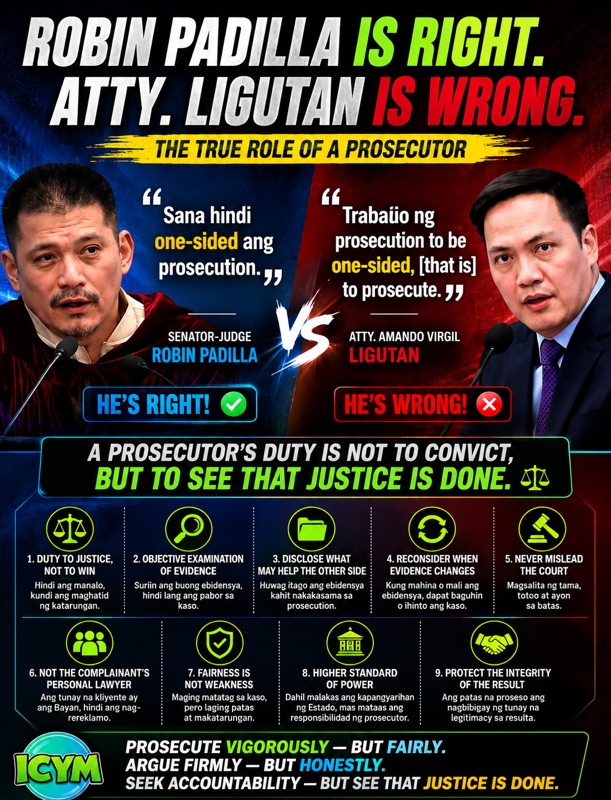
ROBIN PADILLA VS. ATTY. LIGUTAN: WHO GOT THE LAW RIGHT?
By Anthony Ludalvi A. Vista (Rewritten)
A heated exchange during the impeachment proceedings against Vice President Sara Duterte sparked a debate that goes beyond politics—it cuts to the very heart of justice.
When Senator-Judge Robin Padilla reminded the prosecution not to be one-sided, Atty. Amando Virgil Ligutan fired back, saying that prosecutors are supposed to be one-sided because their job is to prosecute, while the defense defends and the judges remain impartial.
That may sound logical at first—but legally and ethically, it misses the mark.
A Prosecutor’s Job Isn’t Just to Win—It’s to Deliver Justice
Many lawyers, including experienced prosecutors, initially see their role as securing convictions. But the law expects something greater.
A prosecutor is not just another lawyer fighting to win. A prosecutor is a minister of justice—an officer of the court whose ultimate duty is fairness, truth, and justice.
The Supreme Court has made this crystal clear:
“The duty of a public prosecutor is not to convict but to see that justice is done.”
That means prosecutors cannot hide evidence, ignore facts that weaken their case, or pursue victory at all costs.
Why Robin Padilla’s Point Matters
Senator Padilla was not asking prosecutors to defend the accused.
He was reminding them that while they must prosecute vigorously, they must also remain fair, objective, and truthful.
There’s a huge difference between:
- Being aggressive in presenting evidence, and
- Being blindly partisan regardless of the facts.
The first is justice.
The second is misconduct.
A Real Prosecutor Must Stay Objective
A responsible prosecutor examines all the evidence—not just the pieces that support conviction.
That includes:
- Weaknesses in the prosecution’s case.
- Contradictory testimony.
- Credibility issues.
- Evidence favorable to the respondent.
Justice demands honesty—not tunnel vision.
You Can’t Hide the Truth
If prosecutors were truly meant to be completely one-sided, they could simply bury evidence that helps the other side.
The law forbids exactly that.
A prosecutor has a legal and ethical obligation to disclose material evidence—even when it weakens the government’s case.
That’s because justice is never served by hiding the truth.
When New Evidence Appears, Prosecutors Must Adjust
Justice doesn’t stop once charges are filed.
If new evidence proves a witness unreliable or shows an allegation cannot be sustained, prosecutors must be willing to:
- Reduce charges.
- Withdraw allegations.
- Concede weak points.
- Even drop the case when warranted.
Continuing a hopeless case just to avoid embarrassment is not justice—it’s abuse of power.
The Court Must Never Be Misled
A prosecutor remains an officer of the court.
That means:
- Present the law accurately.
- Present facts honestly.
- Avoid exaggeration.
- Correct mistakes.
- Never create a false impression just to strengthen the case.
Winning through deception is never a victory for justice.
The Prosecutor Represents the People—Not Personal Interests
The complainant may want revenge.
The public may demand punishment.
Politics may demand headlines.
But prosecutors serve the People, not personal or political agendas.
Their loyalty belongs to justice alone.
Fair Doesn’t Mean Weak
Being fair doesn’t mean being soft.
A prosecutor can:
- Cross-examine aggressively.
- Challenge weak testimony.
- Argue passionately.
- Seek conviction with confidence.
But every argument must remain grounded in law, evidence, and truth.
Why Prosecutors Are Held to a Higher Standard
The State has enormous power.
It can investigate.
It can arrest.
It can subpoena.
It can restrict liberty.
Because of that power, prosecutors carry a greater responsibility to act with fairness and restraint.
The stronger the government’s power, the stronger its duty to pursue justice—not simply victory.
The Bottom Line
Senator Robin Padilla’s statement reflected a long-standing legal principle:
A prosecutor must prosecute vigorously—but never unfairly.
Atty. Ligutan was correct in saying prosecutors present the case against the respondent.
But saying prosecutors are “supposed to be one-sided” oversimplifies—and misstates—the prosecutor’s legal duty.
Justice is not about winning.
Justice is about discovering the truth, respecting due process, and ensuring that the right outcome is reached.
A prosecutor’s greatest victory is not a conviction.
It is knowing that justice has truly been served.
No comments:
Post a Comment