Showing posts with label Political. Show all posts

Saturday, August 22, 2026

YOU DO NOT BEND THE LAW: THE 16-VOTE STANDARD REMAINS

August 22, 2026 | Philippine Politics

The debate over the impeachment trial of Vice President Sara Duterte has once again placed one constitutional number at the center of national attention: 16 votes.

Under Article XI, Section 3(6) of the 1987 Philippine Constitution, no person facing impeachment may be convicted without the concurrence of two-thirds of all the members of the Senate.

With a 24-member Senate, two-thirds means 16 senators must vote to convict.

16 Votes — Not a Simple Majority

The constitutional wording is important because it refers to two-thirds of all members of the Senate, rather than simply two-thirds of the senators who happen to be present when the vote is taken.

That distinction has become particularly significant amid discussions surrounding attendance, abstentions, and the voting threshold during the impeachment proceedings.

The central principle is straightforward:

The constitutional standard should not be rewritten in the middle of a trial simply because a different threshold would make a particular outcome easier to achieve.

Whether the accused is Vice President Sara Duterte or any other impeachable official, the same constitutional safeguards must apply.

Impeachment Is a Constitutional Process

An impeachment trial is not an ordinary political vote.

The House of Representatives brings the charges, while the Senate sits as the impeachment court and ultimately determines whether the evidence presented is sufficient to convict.

That enormous responsibility makes due process essential.

The prosecution must be allowed to present its evidence and arguments. The defense must be given a meaningful opportunity to answer the allegations. Senator-judges must then evaluate the case before casting their votes.

Political popularity, public pressure, party affiliation, or personal preference should never replace the constitutional process.

Why the 16-Vote Requirement Matters

The two-thirds requirement creates a deliberately high threshold for removing an impeachable official from office.

A conviction can carry extraordinary consequences, so the Constitution requires more than an ordinary majority before such a judgment can be imposed.

This does not guarantee an acquittal.

Neither does it guarantee a conviction.

It simply establishes the constitutional standard that must be satisfied.

If the prosecution proves its case and obtains at least 16 votes, the constitutional requirement for conviction is met. If it fails to secure that number, the requirement is not met.

Due Process Must Apply to Everyone

Defending the constitutional process should not automatically be interpreted as defending or attacking Vice President Sara Duterte.

The deeper issue is institutional.

Rules designed to protect fairness matter most when political emotions are running high. A constitutional safeguard has little meaning if it is respected only when it produces the result one side wants.

The same rules we demand for our political opponents must also be followed when they protect people we disagree with.

That is the essence of equal treatment under established procedures.

Evidence Must Decide the Case

Ultimately, the impeachment trial should revolve around evidence, law, and due process.

If the allegations are supported by sufficient evidence, that evidence should be examined fairly and transparently. If the defense can successfully challenge those allegations, its arguments must also receive proper consideration.

The Filipino people deserve more than political theater.

They deserve a process in which the rules are known beforehand, consistently applied, and respected until the final judgment.

The Constitution Sets the Standard

There will undoubtedly be intense political debate surrounding the impeachment proceedings.

That is expected in a democracy.

But constitutional requirements should remain above political convenience.

You do not bend the law to obtain the result you want. You follow the law and allow the constitutional process to determine the result.

Whether the final verdict is conviction or acquittal, Filipinos deserve confidence that the decision was reached according to the same rules from beginning to end.

16 votes means 16 votes.

For truth.
For due process.
For a fair trial.
For the Filipino people.

#SaraDuterte #ImpeachmentTrial #16Votes #DueProcess #RuleOfLaw #PhilippineConstitution #PhilippinePolitics #Senate #InCaseYouMissedPH



Tuesday, August 11, 2026

DOJ Dismisses Inciting to Sedition Complaint Against Vice President Sara Duterte

MANILA, Philippines — The Department of Justice (DOJ) has dismissed the inciting to sedition complaint filed against Vice President Sara Duterte, marking another significant legal development involving the country’s second-highest official.

According to DOJ spokesperson Atty. Polo Martinez, the panel of prosecutors found insufficient basis to pursue the complaint against the Vice President.

Prosecutors Find Insufficient Basis

The dismissal means that, after evaluating the allegations and supporting evidence presented in the complaint, prosecutors determined that there was not enough legal basis to move forward with the inciting to sedition case.

A dismissal at the prosecutorial level does not necessarily amount to a court ruling on guilt or innocence. Rather, it means prosecutors did not find sufficient grounds to pursue the charge based on the complaint and evidence presented for evaluation.

What Is Inciting to Sedition?

Under Philippine law, inciting to sedition generally involves encouraging others, through speeches, writings, statements, or other means, to commit acts that fall within the legal definition of sedition.

Because political criticism, disagreement with government officials, and freedom of expression are protected rights, allegations involving inciting to sedition require careful consideration of both the specific statements or actions involved and the elements required by law.

Significant Development for VP Sara Duterte

The DOJ’s decision represents an important development for Vice President Sara Duterte, who continues to face intense political and legal scrutiny.

For her supporters, the dismissal may reinforce their argument that accusations against the Vice President must be supported by strong and credible evidence before legal proceedings are pursued.

Critics, meanwhile, may continue to scrutinize her statements and actions and seek accountability through appropriate legal and constitutional processes.

Regardless of political affiliation, the principle should remain the same: serious accusations against any public official must be evaluated according to evidence, due process, and the law—not simply political sentiment.

The Bigger Picture

In a deeply divided political environment, legal cases involving prominent government officials can quickly become political flashpoints.

The DOJ’s dismissal highlights why it is important to distinguish between political controversy and allegations that can actually satisfy the requirements of a criminal case.

Accountability remains essential in a democracy, but so does due process. Public officials should be investigated when credible evidence warrants it, while accusations that fail to meet legal standards should not automatically be treated as established facts.

As reactions to the DOJ decision emerge, the public debate surrounding Vice President Sara Duterte and the country’s broader political landscape is likely to continue.

What do you think about the DOJ’s decision? Was the dismissal justified based on the available evidence? Share your views respectfully.

Follow InCaseYouMissed for Philippine news, political developments, analysis, and stories you may have missed.

#SaraDuterte #VPSara #DOJ #DepartmentOfJustice #PhilippinePolitics #Philippines #SeditionCase #BreakingNews #NewsUpdate #InCaseYouMissed


Tuesday, August 04, 2026

Ex-COA Auditor Testifies VP Sara Duterte Was the Only Vice President He Audited With Confidential Funds

Introduction

A former Commission on Audit (COA) official told the Senate impeachment court that Vice President Sara Duterte was the only vice president he had audited whose office received confidential funds, providing another key testimony during the ongoing impeachment proceedings.

Context

On the 11th day of the impeachment trial held on Monday, August 3, former COA-ICFAO State Auditor Roderick Wamil appeared before the Senate impeachment court as a prosecution witness.

During his testimony, Wamil explained that he did not conduct audits involving confidential funds for former Vice Presidents Jejomar Binay and Leni Robredo because their offices had no budget appropriations for confidential funds during their respective terms.

He also testified that the Department of Education (DepEd) only began receiving confidential funds after Sara Duterte assumed the position of Education Secretary.

Key Points From the Testimony

According to Wamil:

  • Vice President Sara Duterte was the only vice president whose confidential funds he audited.
  • Former Vice Presidents Jejomar Binay and Leni Robredo had no confidential fund appropriations, leaving no such funds to audit.
  • DepEd’s confidential funds were introduced during Duterte’s tenure as Secretary of Education.

Before Wamil took the witness stand, former Land Bank officials also testified regarding the release and encashment of substantial cash withdrawals related to confidential fund transactions. Their testimonies formed part of the documentary and testimonial evidence presented before the impeachment court.

Why It Matters

The prosecution continues to present witnesses and documentary evidence to support its case before the Senate impeachment court. Testimonies from former government auditors and banking officials are intended to establish the handling, release, and audit trail of confidential funds.

The defense will have the opportunity to cross-examine witnesses and present its own evidence as the impeachment trial proceeds.

Commentary

The testimony presented by former auditor Roderick Wamil adds another piece to the broader discussion surrounding the management and audit of confidential funds. While the statements are now part of the official impeachment record, the Senate impeachment court has yet to determine their legal significance. As with all impeachment proceedings, the final outcome will depend on the totality of evidence presented by both the prosecution and the defense.

Conclusion

With more witnesses expected to testify, the impeachment trial continues to examine the use, disbursement, and auditing of confidential funds. The proceedings remain ongoing, and the Senate impeachment court will ultimately decide the case based on the evidence and arguments presented by both sides.


Monday, July 27, 2026

FAMILY TIES ON THE LINE?

President Marcos Jr. Says the Law Comes First—Even If It Means His Cousin Faces Charges


Introduction

One of the strongest moments in President Ferdinand “Bongbong” Marcos Jr.’s fifth State of the Nation Address (SONA) was his declaration that no one is above the law—not even members of his own family.

The statement comes as public attention intensifies over reports that the Office of the Ombudsman is preparing to file multiple cases against former House Speaker Martin Romualdez, who is also the President’s first cousin.

Background

For years, Romualdez was considered one of the most influential political figures in the country and a close ally of President Marcos. Their family relationship has often been viewed as a symbol of political unity within the administration.

Now, that relationship is under the spotlight as legal proceedings are reportedly being prepared against the former Speaker.

What the President Said

President Marcos acknowledged that the situation is personally difficult but emphasized that his responsibility as the country’s leader must come before family loyalty.

“It may be painful, but it has to be done. I am not the President of my family. I am not the President of my friends.”

The President stressed that justice must be enforced fairly and impartially, regardless of a person’s position, political influence, or relationship with him.

Why This Matters

If legal cases are formally filed, the development could become one of the most significant political stories of the year. It will test the administration’s commitment to accountability and the principle that every public official is subject to the rule of law.

At the same time, the legal process remains important. Allegations and planned charges are not findings of guilt. Any cases filed would still have to go through the courts, where those involved have the right to defend themselves.

Public Reaction

The President’s remarks have sparked widespread discussion. Some view the statement as a strong commitment to equal justice, while others believe the public should wait for the legal process to unfold before drawing conclusions.

As developments continue, Filipinos will be watching closely to see how the case progresses and whether the administration’s words are matched by action.

Conclusion

President Marcos Jr.’s message was clear: the rule of law should take precedence over personal relationships. Whether this principle will be tested in court remains to be seen, but the issue is likely to remain at the center of national attention in the coming months.


Source: Statements made during President Ferdinand Marcos Jr.‘s Fifth State of the Nation Address (SONA) and reports regarding the Office of the Ombudsman’s reported plan to file cases against former House Speaker Martin Romualdez.


Saturday, July 25, 2026

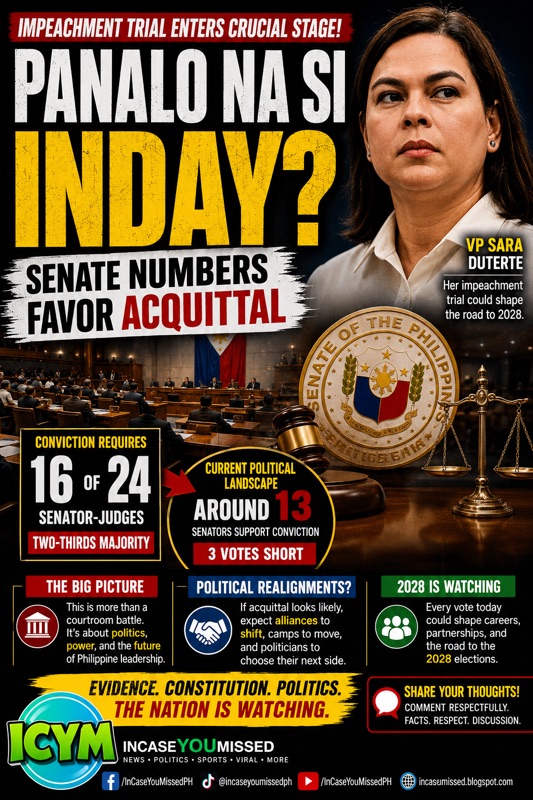
WILL INDAY SURVIVE? | SENATE NUMBERS APPEAR TO FAVOR VP SARA DUTERTE AS IMPEACHMENT TRIAL REACHES ITS MOMENT OF TRUTH

MANILA, Philippines — The impeachment trial of Vice President Sara Duterte has entered its most explosive stage. But as legal arguments intensify inside the Senate, many political observers believe the real battle may come down to one thing: the numbers.

The Constitution is crystal clear. Convicting an impeached official requires 16 out of 24 senator-judges—a two-thirds majority. Anything less results in acquittal.

THE MATH ISN’T SIMPLE

Based on current political alignments, many analysts believe the prosecution can presently count on roughly 13 votes—still three short of the constitutional requirement.

If those estimates prove accurate, the advantage currently appears to lean toward acquittal.

That leaves the House prosecution with a monumental task: not only must it prove the allegations, but it must also persuade enough senator-judges to break away from existing political alignments.

Until then, Senate arithmetic may remain the biggest obstacle standing between the prosecution and a conviction.

MORE THAN A LEGAL BATTLE

Every senator-judge knows this vote will echo far beyond the impeachment court.

With the 2028 presidential election already on the political horizon, every decision could shape reputations, influence alliances, and define political futures.

Some senators may vote solely on the evidence presented before the court. Others may also weigh the broader political consequences that could follow long after the verdict is announced.

THE POLITICAL CHESSBOARD IS ALREADY MOVING

Political analysts say that if acquittal begins to look increasingly likely, expect the country’s political landscape to shift rapidly.

History has shown that Philippine politics rarely stays still.

Alliances evolve.

Former rivals become partners.

Political fences are mended.

And politicians often reposition themselves where they believe the next center of power will emerge.

If Vice President Duterte leaves the impeachment court acquitted, many observers believe it could trigger fresh negotiations, new alliances, and strategic realignments ahead of the 2028 elections.

THE BIGGER STORY

This is no longer just a constitutional trial.

It is a test of legal arguments, political influence, public perception, and Senate arithmetic—all unfolding on the national stage.

The prosecution still has the opportunity to present additional evidence and persuade undecided senator-judges. Likewise, the defense must continue to answer the allegations before the impeachment court.

At this point, however, one question continues to dominate political discussions:

Can the prosecution flip enough votes to reach the magic number of 16, or will the Senate numbers ultimately deliver an acquittal?

The final answer will come only when every senator-judge casts a vote based on the proceedings and the standards required by the Constitution.

💬 Is this impeachment trial really about the evidence, the numbers, or both? Share your opinion respectfully in the comments. Healthy debate is welcome—but let’s keep it factual and civil.