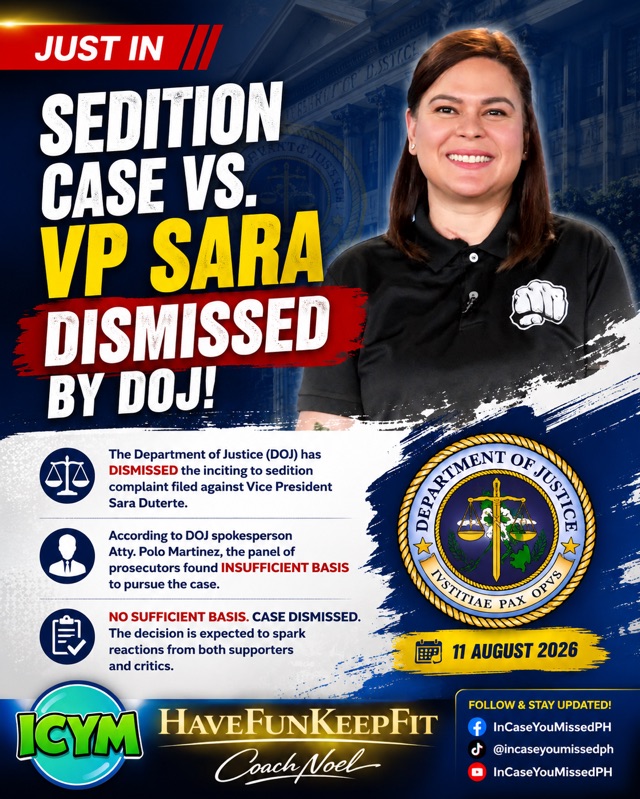
MANILA, Philippines — The Department of Justice (DOJ) has dismissed the inciting to sedition complaint filed against Vice President Sara Duterte, marking another significant legal development involving the country’s second-highest official.
According to DOJ spokesperson Atty. Polo Martinez, the panel of prosecutors found insufficient basis to pursue the complaint against the Vice President.
Prosecutors Find Insufficient Basis
The dismissal means that, after evaluating the allegations and supporting evidence presented in the complaint, prosecutors determined that there was not enough legal basis to move forward with the inciting to sedition case.
A dismissal at the prosecutorial level does not necessarily amount to a court ruling on guilt or innocence. Rather, it means prosecutors did not find sufficient grounds to pursue the charge based on the complaint and evidence presented for evaluation.
What Is Inciting to Sedition?
Under Philippine law, inciting to sedition generally involves encouraging others, through speeches, writings, statements, or other means, to commit acts that fall within the legal definition of sedition.
Because political criticism, disagreement with government officials, and freedom of expression are protected rights, allegations involving inciting to sedition require careful consideration of both the specific statements or actions involved and the elements required by law.
Significant Development for VP Sara Duterte
The DOJ’s decision represents an important development for Vice President Sara Duterte, who continues to face intense political and legal scrutiny.
For her supporters, the dismissal may reinforce their argument that accusations against the Vice President must be supported by strong and credible evidence before legal proceedings are pursued.
Critics, meanwhile, may continue to scrutinize her statements and actions and seek accountability through appropriate legal and constitutional processes.
Regardless of political affiliation, the principle should remain the same: serious accusations against any public official must be evaluated according to evidence, due process, and the law—not simply political sentiment.
The Bigger Picture
In a deeply divided political environment, legal cases involving prominent government officials can quickly become political flashpoints.
The DOJ’s dismissal highlights why it is important to distinguish between political controversy and allegations that can actually satisfy the requirements of a criminal case.
Accountability remains essential in a democracy, but so does due process. Public officials should be investigated when credible evidence warrants it, while accusations that fail to meet legal standards should not automatically be treated as established facts.
As reactions to the DOJ decision emerge, the public debate surrounding Vice President Sara Duterte and the country’s broader political landscape is likely to continue.
What do you think about the DOJ’s decision? Was the dismissal justified based on the available evidence? Share your views respectfully.
Follow InCaseYouMissed for Philippine news, political developments, analysis, and stories you may have missed.
#SaraDuterte #VPSara #DOJ #DepartmentOfJustice #PhilippinePolitics #Philippines #SeditionCase #BreakingNews #NewsUpdate #InCaseYouMissed
No comments:
Post a Comment