Showing posts with label Crime. Show all posts

Monday, July 27, 2026

Emergency Hand Signal

A Silent Cry for Help That Everyone Should Know

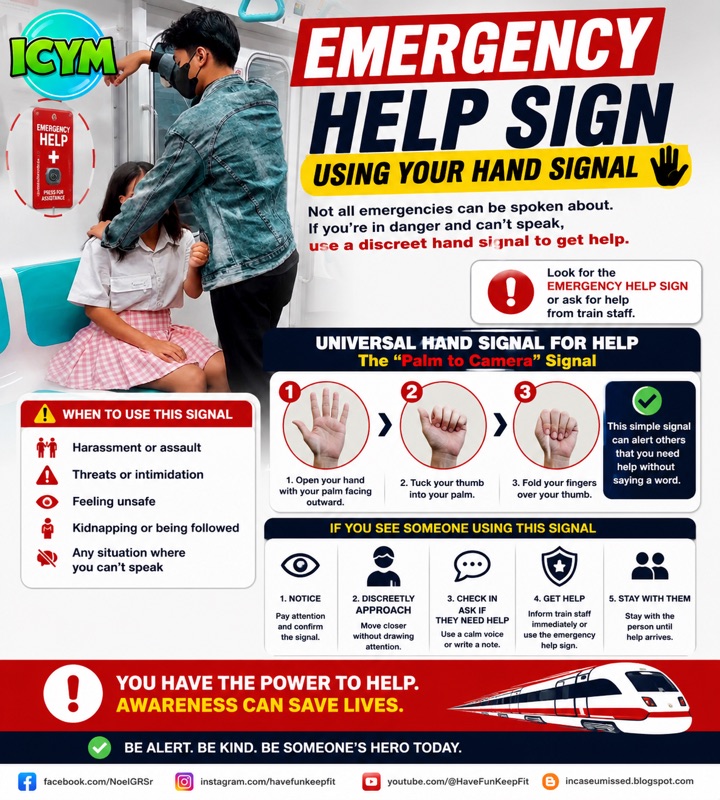
Not every emergency can be spoken aloud. In situations where a person feels threatened, trapped, or unable to call for help, a simple hand gesture can silently alert others that assistance is needed.

The Universal Hand Signal for Help gained worldwide recognition as a discreet way for someone to signal they are in danger. It has been used in cases involving harassment, domestic violence, kidnapping attempts, and other situations where speaking could put the person at greater risk.

✋ How to perform the Emergency Hand Signal:

1. Raise your hand with your palm facing outward.

2. Fold your thumb into the center of your palm.

3. Close your fingers over your thumb to form a fist.

👀 If you see someone using this signal:

* Stay calm and don’t draw attention to the situation.

* Observe the person’s condition and surroundings.

* Quietly ask if they need help when it is safe.

* Notify security personnel, train staff, or emergency responders immediately.

* Stay nearby if it is safe until help arrives.

⚠️ When should this signal be used?

* Harassment or assault

* Threats or intimidation

* Kidnapping or human trafficking concerns

* Domestic violence

* Any situation where speaking openly is unsafe

Awareness can save lives. Many people recognize emergency alarms but are unaware that a silent hand signal can communicate the same urgent need for help. Learning this simple gesture—and knowing how to respond appropriately—can make you the person who changes someone’s outcome for the better.

🤝 A small gesture can carry a powerful message. Learn it. Remember it. Share it. One day, recognizing this silent signal could help save a life.

📢 Help spread awareness by sharing this post with your family, friends, classmates, and coworkers. The more people who recognize this signal, the safer our communities become.

#EmergencyHandSignal #SignalForHelp #PublicSafety #StayAlert #TrainSafety #EmergencyAwareness #KnowTheSigns #BeSomeoneHero #SafetyFirst #ICYM #InCaseYouMissed

👉 Follow InCaseYouMissed (ICYM) for educational content, public safety awareness, breaking news, and informative updates that matter.


Comment:

💬 Before today, did you know about the Universal Hand Signal for Help? If you ever witnessed someone using it, what would you do? Share your thoughts respectfully in the comments below.

​VP Sara Duterte Says FPRRD Could Return Home Next Week


Vice President Sara Duterte stirred discussion after telling supporters during a public gathering that former President Rodrigo Duterte (FPRRD) could return home “next week.” The statement was met with loud cheers and quickly gained traction across social media platforms, prompting renewed public interest in the ongoing legal proceedings involving the former president.

As with many high-profile political developments, the remarks have generated both optimism among supporters and questions from observers awaiting official updates.


Background

Former President Rodrigo Duterte remains at the center of legal proceedings that continue to attract national and international attention. The developments have become a major topic in Philippine politics, with supporters and critics closely following every announcement.

Throughout the process, Vice President Sara Duterte has remained vocal in expressing support for her father, while many of their supporters continue to organize gatherings and public events to demonstrate solidarity.


What VP Sara Said

Addressing supporters during the event, VP Sara expressed confidence that FPRRD could be back home as early as next week.

Her remarks were greeted with applause and chants from the crowd, reflecting the optimism shared by many of those in attendance.

At the time of writing, however, there has been no official confirmation from the relevant legal authorities regarding any specific timetable for developments in the case.


Why This Statement Matters

The Vice President’s statement is significant because it highlights the continuing public and political interest surrounding the Duterte family’s legal and political situation.

It also demonstrates the strong support that the former president continues to receive from many Filipinos.

At the same time, it is important to recognize that legal proceedings follow established judicial processes. Any official outcome or change in status will depend on decisions made by the appropriate authorities.


Public Reaction

The statement quickly became a trending topic online.

Supporters welcomed the message with hope and optimism, expressing confidence that positive developments could be forthcoming.

Others urged caution, emphasizing the importance of waiting for official announcements before drawing conclusions.

The differing reactions reflect the diverse opinions surrounding one of the country’s most closely watched political issues.


Why Verified Information Matters

Political developments often spread rapidly through social media, where speculation can sometimes outpace verified facts.

Readers are encouraged to:

  • Follow updates from credible news organizations.
  • Wait for official statements from the appropriate authorities.
  • Distinguish between political expressions of hope and confirmed legal decisions.

Responsible sharing of information helps promote informed public discussion.


Conclusion

Vice President Sara Duterte’s latest remarks have once again placed the spotlight on the legal situation involving former President Rodrigo Duterte. Whether the anticipated development materializes will ultimately depend on official legal decisions and announcements.

Until then, the public is encouraged to stay informed through reliable sources and to approach ongoing developments with both interest and patience.


Editor’s Note

This article is based on a public statement delivered during a public event. It reports the statement and its public significance. Any legal outcome concerning former President Rodrigo Duterte remains subject to official proceedings and announcements.


Source

Public rally video and publicly available reports regarding the event.

VP Sara Duterte, Rodrigo Duterte, FPRRD, Philippine politics, latest news, legal proceedings, breaking news, InCaseYouMissed, ICYM

Follow InCaseYouMissed (ICYM)

Stay updated with balanced coverage of Philippine news, politics, current events, sports, viral stories, and trending topics.


What are your thoughts on VP Sara Duterte’s statement? Share your opinion respectfully in the comments below.


Saturday, July 25, 2026

WILL INDAY SURVIVE? | SENATE NUMBERS APPEAR TO FAVOR VP SARA DUTERTE AS IMPEACHMENT TRIAL REACHES ITS MOMENT OF TRUTH

MANILA, Philippines — The impeachment trial of Vice President Sara Duterte has entered its most explosive stage. But as legal arguments intensify inside the Senate, many political observers believe the real battle may come down to one thing: the numbers.

The Constitution is crystal clear. Convicting an impeached official requires 16 out of 24 senator-judges—a two-thirds majority. Anything less results in acquittal.

THE MATH ISN’T SIMPLE

Based on current political alignments, many analysts believe the prosecution can presently count on roughly 13 votes—still three short of the constitutional requirement.

If those estimates prove accurate, the advantage currently appears to lean toward acquittal.

That leaves the House prosecution with a monumental task: not only must it prove the allegations, but it must also persuade enough senator-judges to break away from existing political alignments.

Until then, Senate arithmetic may remain the biggest obstacle standing between the prosecution and a conviction.

MORE THAN A LEGAL BATTLE

Every senator-judge knows this vote will echo far beyond the impeachment court.

With the 2028 presidential election already on the political horizon, every decision could shape reputations, influence alliances, and define political futures.

Some senators may vote solely on the evidence presented before the court. Others may also weigh the broader political consequences that could follow long after the verdict is announced.

THE POLITICAL CHESSBOARD IS ALREADY MOVING

Political analysts say that if acquittal begins to look increasingly likely, expect the country’s political landscape to shift rapidly.

History has shown that Philippine politics rarely stays still.

Alliances evolve.

Former rivals become partners.

Political fences are mended.

And politicians often reposition themselves where they believe the next center of power will emerge.

If Vice President Duterte leaves the impeachment court acquitted, many observers believe it could trigger fresh negotiations, new alliances, and strategic realignments ahead of the 2028 elections.

THE BIGGER STORY

This is no longer just a constitutional trial.

It is a test of legal arguments, political influence, public perception, and Senate arithmetic—all unfolding on the national stage.

The prosecution still has the opportunity to present additional evidence and persuade undecided senator-judges. Likewise, the defense must continue to answer the allegations before the impeachment court.

At this point, however, one question continues to dominate political discussions:

Can the prosecution flip enough votes to reach the magic number of 16, or will the Senate numbers ultimately deliver an acquittal?

The final answer will come only when every senator-judge casts a vote based on the proceedings and the standards required by the Constitution.

💬 Is this impeachment trial really about the evidence, the numbers, or both? Share your opinion respectfully in the comments. Healthy debate is welcome—but let’s keep it factual and civil.


Friday, July 10, 2026

​“SECRET PLAN?” LEVISTE QUESTIONS TINIO FOR POSTING PHOTO OF PRIVATE MEETING WITH ERICE


A social media exchange involving Batangas 1st District Rep. Leandro Legarda Leviste, ACT Teachers Party-list Rep. Antonio Tinio, and Caloocan Rep. Egay Erice has sparked political curiosity after references were made to an alleged “secret plan.”

Leviste publicly questioned Tinio over why he posted a photo of what appeared to be a private meeting involving the three lawmakers, suggesting that whatever they had discussed was supposedly meant to remain confidential and eventually come as a surprise.

In a Facebook post, Leviste asked Tinio why he had shared the group photo online, saying he had expected their alleged plan to remain secret.

Leviste wrote:

“Why did you post this picture of our meeting with Cong. Erice about the secret plan, Cong. Tinio? I thought the plan was to just surprise them.”

His remark came in response to an earlier post by Tinio, who uploaded the photo and wrote:

“Inciting, you say? 😂 The push to hold BBM accountable is not being abandoned.”

Tinio then directly addressed Leviste’s followers, urging them to pressure the Batangas lawmaker to release what Tinio claimed was evidence against President Ferdinand “Bongbong” Marcos Jr.

Tinio added:

“To the followers of Cong. Leandro Legarda Leviste, convince him to release the evidence he has against BBM. Why keep sitting on it?”


The exchange immediately raised questions because both Leviste and Tinio referred—directly or indirectly—to a supposed “secret plan,” yet neither publicly explained what that plan actually involved.

Several important questions therefore remain unanswered:

  • What exactly was discussed during the meeting?
  • What is the alleged “secret plan”?
  • Who is the intended target or subject of the supposed next move?
  • What evidence was Tinio referring to?
  • Will Leviste eventually release any documents, records, or other material he may possess?
  • Was the social media exchange serious, strategic, humorous, or partly intended to build public anticipation?

At this stage, there is not enough publicly disclosed information in the statements quoted above to determine the exact nature of the alleged plan. Any claim about its contents would therefore be speculation unless the lawmakers themselves provide further details or supporting documents.

This is where the political intrigue becomes difficult to ignore.

If the exchange was serious, the meeting could signal coordination among lawmakers or political figures seeking to pursue accountability issues involving the Marcos administration. Tinio’s statement that they are not abandoning efforts to hold BBM accountable gives the discussion an unmistakably political dimension.

However, the public should also remain cautious. The phrase “secret plan” is dramatic and naturally attracts attention, but a cryptic social media post is not the same as verified evidence or an officially announced political action.

The more significant issue may be Tinio’s claim that Leviste possesses evidence against President Marcos. If such evidence exists and concerns a matter of genuine public interest, the next question is whether it will be formally disclosed, authenticated, and presented through the appropriate legal, congressional, or public accountability process.

Until then, the story remains politically explosive—but incomplete.

For now, the alleged “secret plan” remains exactly that: undisclosed.

What is clear is that the public exchange among Leviste, Tinio, and Erice has fueled speculation about possible future political moves and renewed questions about alleged evidence involving President Marcos.

Will this lead to a major disclosure, a congressional initiative, a legal action, or simply another round of political messaging?

The next move could provide the answer.

Mentions:

Leandro Legarda Leviste
Antonio Tinio
Egay Erice
Ferdinand “Bongbong” Marcos Jr.
ACT Teachers Party-list
House of Representatives
Philippine Politics
Political Accountability

Hashtags:

#SecretPlan #LeandroLeviste #AntonioTinio #EgayErice #BBM #BongbongMarcos #PhilippinePolitics #PoliticalNews #BreakingNewsPH #Accountability #CongressPH #HouseOfRepresentatives #InCaseYouMissed #InCaseYouMissedPH

Follow:

Follow InCaseYouMissedPH for more updates, political developments, breaking stories, public affairs, and important issues shaping the Philippines.

💬 What do you think the alleged “secret plan” could be? Share your opinion in the comments—but keep the discussion respectful and fact-based.

📌 Read more updates and follow for the next development.


PROSECUTION WITNESS, MAY SARILI UMANONG CRIMINAL CASE?


 “PATONG-PATONG PALA ANG KASO MO!” — PROSECUTION WITNESS, MAY SARILI UMANONG CRIMINAL CASE? 

Isang eksena ang umani ng matinding reaksyon online matapos lumutang ang alegasyon na ang isang witness na iniuugnay sa prosecution ay mayroon din umanong kinakaharap na criminal case. Dahil dito, marami ang napatanong: Makaaapekto ba ito sa credibility ng witness at sa bigat ng kanyang testimonya?

Batay sa viral post at video clip, tila nagkaroon ng tensyon nang mapag-usapan ang legal background ng witness. Kumalat din ang linyang:

“Patong-patong pala ang kaso mo… paano na tayo manalo nito?”

May mga netizen ding nagkomento na kung ang isang testigo ay may sarili ring kasong kinakaharap, maaaring kuwestiyunin ng kabilang panig ang kanyang motibo, credibility, o posibleng personal interest sa usapin.

Mahalagang linawin na ang pagkakaroon ng pending criminal case ay hindi awtomatikong nangangahulugan na nagsisinungaling ang isang witness o wala nang halaga ang kanyang testimonya. Sa legal proceedings, maaaring suriin ang credibility ng witness batay sa consistency ng salaysay, supporting evidence, personal knowledge, possible bias, motive, at iba pang admissible evidence.

Gayundin, ang isang pending case ay hindi katumbas ng conviction. May presumption of innocence hangga’t walang final judgment of guilt. Kaya hindi sapat ang viral caption, edited clip, o social-media reaction para agad magdeklara kung sino ang nagsasabi ng totoo.

Para sa akin, dito dapat manaig ang ebidensya kaysa emosyon at political loyalty. Kung may kaso ang witness, dapat malinaw kung ano ang tunay na status nito at kung relevant ba iyon sa kanyang credibility. Pero hindi rin tama na awtomatikong burahin ang buong testimonya dahil lamang sa isang alegasyon o pending complaint.

Sa kabilang banda, kung mapapatunayang may conflict of interest, personal motive, inconsistent statements, o material credibility issue, karapatan ng kabilang panig na siyasatin at hamunin iyon sa tamang proseso.

Sa huli, ang korte at tamang legal process ang dapat magpasya—hindi memes, chismis, o viral posts. Suriin ang buong hearing, alamin ang complete context, at ihiwalay ang verified facts sa political spin.


@followers @everyone

Ano ang tingin ninyo? Makaaapekto ba sa credibility ng isang witness kung mayroon din siyang pending criminal case, o dapat testimonya at ebidensya lamang ang pagbasehan?

#PhilippinePolitics #LegalNewsPH #ProsecutionWitness #CriminalCase #Justice        

Follow InCaseYouMissedPH / HaveFunKeepFit – Coach Noel for more news updates, explainers, commentary, and trending stories.

📘 Facebook:  ⁠Noel G.R. Sr. on Facebook

📸 Instagram:  ⁠HaveFunKeepFit on Instagram

▶️ YouTube:  ⁠HaveFunKeepFit on YouTube

📰 Read more:  ⁠In Case You Missed Blog

Friday, June 26, 2026

Will They Go to Jail or Not?

They say, “Don’t touch this child” — Kiko and Human Rights might protest. 


Will They Go to Jail or Not?

As the details of the Tacloban school shooting become clearer, reports say that the 14-year-old allegedly played the main role and fired at least 33 shots, while the 15-year-old allegedly fired only once — and missed.

This means one appears to have had a much bigger role in the incident, while the other had a smaller participation. But under R.A. No. 9344, or the Juvenile Justice Law, the first question of the law is not who fired more shots.

The first question is: How old are they?

Even if we assume that they knew what they were doing, understood the consequences of their actions, and knew that what they did was wrong, the law will still treat them differently.

That is how the Juvenile Justice Law works.


The 14-Year-Old

Exempt from criminal liability

Under Section 6 of R.A. No. 9344, a child 15 years old or below is exempt from criminal liability. This means he cannot be charged and punished like an adult offender.

The law will no longer ask whether he was the main shooter. It will no longer ask how many times he fired. Even if there appears to be planning and clear understanding of the act, age still ends the criminal inquiry.

So if it is proven that he is 14 years old, he will not go through ordinary criminal prosecution. There will be no normal arraignment, no regular adult trial, no conviction, and no ordinary prison sentence.

The case will be brought to social welfare

But this does not mean he will simply go home as if nothing happened.

Under the law, he must undergo intervention. He will be referred to the Local Social Welfare and Development Officer, or LSWDO, where his family background, mental and emotional condition, education, behavior, and overall situation will be assessed.

From there, he may undergo counseling, therapy, family intervention, education programs, and rehabilitation.

In a serious case like this, especially where lives were lost, there is a strong possibility that he may be placed in Bahay Pag-asa — a youth care facility for children in conflict with the law.

It is not a jail.
It is a rehabilitation center.


The 15-Year-Old

If proven to have acted with discernment

The situation of the 15-year-old is different.

Under R.A. No. 9344, a child above 15 but below 18 years old may be held liable if it is proven that he acted with discernment.

This means the prosecution must prove that he knew what he was doing, understood the result of his actions, and knew that it was wrong.

If this is proven, the case may proceed. The prosecutor may file the information, the court may acquire jurisdiction, the child may be arraigned, and the trial may begin.

Both sides will present evidence. And if the prosecution proves guilt beyond reasonable doubt, the court may issue a finding of guilt.

But this is where the big difference comes in:
Being found guilty does not automatically mean going straight to jail.


Suspended Sentence: No Immediate Imprisonment

Even if the 15-year-old is found guilty, he will still not be immediately sent to jail.

Under Section 38 of R.A. No. 9344, he may be placed under a suspended sentence. This means the penalty is not immediately enforced.

He will first be given the chance to undergo rehabilitation before the court even decides whether imprisonment is truly necessary.

In simple terms:
A finding of guilt does not automatically mean imprisonment.

The first purpose of the law is reform, not immediate prison bars.


While Under Suspended Sentence

While under suspended sentence, he will not be treated like an adult criminal already serving time in jail.

He may be placed under counseling, education, family intervention, community-based programs, rehabilitation, or an accredited youth rehabilitation facility, depending on the gravity of the case and the needs of the child.

The court will continue to supervise the case. The judge may request reports from the social worker or facility, monitor the child’s progress, and determine whether rehabilitation is working.

This means the 15-year-old remains under court supervision — but he is not immediately imprisoned.


What Happens Afterward?

A suspended sentence does not last forever.

When the proper time for review comes, the court will examine the child’s progress. Three things may happen:

First, the court may extend the suspended sentence and rehabilitation measures until he reaches 21 years old, if the court believes more time is needed for reform.

Second, the court may release him if it finds that rehabilitation was successful and he is ready to return to society.

Third, the court may enforce the sentence if rehabilitation fails and there is no real sign of change.

Only at that point does imprisonment become a real possibility.


The Painful Truth

This is the real design of R.A. No. 9344.

The 14-year-old, even if he was allegedly the main shooter, cannot be charged in an ordinary criminal case because he is exempt from criminal liability due to his age.

The 15-year-old, even if proven to have acted with discernment and even if there is a finding of guilt, will still not be immediately jailed because he will first be given the chance to undergo rehabilitation under court supervision.

And in practical terms, if he follows the program, shows change, and is found capable of returning to society, he may never fully go to prison.

So it is possible — yes, possible — that neither of them will end up in jail.

One is exempt because of age.
The other is given by law a chance to avoid prison through rehabilitation.

This is not speculation.
This is not just opinion.
This is how the law works.

And this is where the public question now explodes:

Where is justice for the victims?
How far should protection for minors go?
And when does mercy become too much when lives have already been lost?

— Tinagalog 

Huwag n’yo raw gagalawin ang batang ito — baka pumalag si Kiko at ang Human Rights. 

Makukulong Ba Sila O Hindi?

Habang lumilinaw ang mga detalye sa Tacloban school shooting, lumalabas sa mga ulat na ang 14-anyos umano ang pangunahing kumilos at nagpaputok ng hindi bababa sa 33 beses, habang ang 15-anyos naman ay umano’y nakapagpaputok lamang ng isang beses — at hindi pa tumama.

Ibig sabihin, may isang tila mas malaking papel sa insidente, habang ang isa ay mas maliit ang naging partisipasyon. Pero sa ilalim ng R.A. No. 9344 o Juvenile Justice Law, ang unang tanong ng batas ay hindi kung sino ang mas maraming pinaputok.

Ang unang tanong ay: Ilang taon sila?

Kahit ipagpalagay na alam nila ang kanilang ginagawa, naiintindihan nila ang epekto ng kanilang kilos, at alam nilang mali ang kanilang ginawa, magkaiba pa rin ang magiging trato ng batas sa kanila.

Ganyan gumagana ang Juvenile Justice Law.


Ang 14-Anyos

Hindi mananagot sa criminal liability

Sa ilalim ng Section 6 ng R.A. No. 9344, ang batang 15 taong gulang pababa ay exempted sa criminal liability. Ibig sabihin, hindi siya maaaring kasuhan at hatulan na parang adult offender.

Hindi na tatanungin ng batas kung siya ba ang pangunahing bumaril. Hindi na rin tatanungin kung ilang beses siya nagpaputok. Kahit pa sabihing may pagpaplano at malinaw na pagkaunawa sa ginawa, ang edad pa rin ang magtatapos sa usaping kriminal.

Kaya kung mapatunayang 14-anyos siya, hindi siya daraan sa ordinaryong criminal prosecution. Walang normal na arraignment, walang regular trial bilang adult, walang conviction, at walang karaniwang sentensya ng pagkakakulong.

Dadalhin ang kaso sa social welfare

Pero hindi ibig sabihin nito ay basta na lang siya uuwi na parang walang nangyari.

Sa ilalim ng batas, kailangan siyang dumaan sa intervention. Ire-refer siya sa Local Social Welfare and Development Officer o LSWDO, kung saan susuriin ang kanyang pamilya, mental at emotional condition, pag-aaral, ugali, at kabuuang kalagayan.

Mula roon, maaaring sumailalim siya sa counseling, therapy, family intervention, education program, at rehabilitation.

Sa seryosong kaso tulad nito, lalo na kung may nasawi, malaki ang posibilidad na ilagay siya sa Bahay Pag-asa — isang youth care facility para sa mga batang may conflict with the law.

Hindi ito kulungan.
Rehabilitation center ito.


Ang 15-Anyos

Kung napatunayang may discernment

Iba naman ang sitwasyon ng 15-anyos.

Sa ilalim ng R.A. No. 9344, ang batang lampas 15 pero wala pang 18 taong gulang ay maaaring managot kung mapapatunayang siya ay kumilos nang may discernment.

Ibig sabihin, kailangang patunayan ng prosecution na alam niya ang kanyang ginagawa, naiintindihan niya ang resulta ng kanyang kilos, at alam niyang mali iyon.

Kapag napatunayan ito, maaaring umusad ang kaso. Maaaring magsampa ng information ang prosecutor, magkaroon ng jurisdiction ang korte, isalang sa arraignment ang bata, at magsimula ang paglilitis.

Magpapakita ng ebidensiya ang magkabilang panig. At kung mapatunayan ng prosecution ang guilt beyond reasonable doubt, maaaring magkaroon ng finding of guilt ang korte.

Pero dito pumapasok ang malaking pagkakaiba:
Hindi ibig sabihin na guilty ay diretso kulungan agad.


Suspended Sentence: Hindi Agarang Bilangguan

Kahit mapatunayang guilty ang 15-anyos, hindi pa rin siya agad ipapadala sa kulungan.

Sa ilalim ng Section 38 ng R.A. No. 9344, maaaring ilagay siya sa suspended sentence. Ibig sabihin, hindi agad ipatutupad ang parusa.

Bibigyan muna siya ng pagkakataong dumaan sa rehabilitation bago pa pag-usapan kung kailangan ba talaga ng imprisonment.

Sa madaling salita:
Ang finding of guilt ay hindi automatic na pagkakakulong.

Unang layunin ng batas ay reporma, hindi agad rehas.


Habang Naka-Suspended Sentence

Habang naka-suspended sentence, hindi siya ituturing na parang adult criminal na nagsisilbi na ng sentensya sa kulungan.

Maaari siyang isailalim sa counseling, education, family intervention, community-based programs, rehabilitation, o ilagay sa accredited youth rehabilitation facility depende sa bigat ng kaso at pangangailangan ng bata.

Mananatiling nakatutok ang korte. Maaaring humingi ang judge ng report mula sa social worker o facility, bantayan ang progreso ng bata, at suriin kung gumagana ang rehabilitation.

Ibig sabihin, ang 15-anyos ay nasa ilalim pa rin ng court supervision — pero hindi pa agad nakakulong.


Ano Ang Mangyayari Pagkatapos?

Hindi panghabambuhay ang suspended sentence.

Kapag dumating ang tamang panahon ng review, titingnan ng korte kung ano ang naging progreso ng bata. May tatlong posibleng mangyari:

Una, maaaring pahabain ang suspended sentence at rehabilitation measures hanggang umabot siya ng 21 taong gulang, kung tingin ng korte ay kailangan pa ng panahon para sa reporma.

Ikalawa, maaaring palayain siya kung makita ng korte na naging matagumpay ang rehabilitation at handa na siyang bumalik sa lipunan.

Ikatlo, maaaring ipatupad ang sentensya kung bigo ang rehabilitation at wala nang nakikitang totoong pagbabago.

Doon pa lamang magiging tunay na posibilidad ang pagkakakulong.


Ang Masakit Na Katotohanan

Ito ang totoong disenyo ng R.A. No. 9344.

Ang 14-anyos, kahit siya pa umano ang pangunahing bumaril, ay hindi maaaring sampahan ng ordinaryong criminal case dahil exempted siya sa criminal liability dahil sa edad.

Ang 15-anyos naman, kahit mapatunayang may discernment at magkaroon ng finding of guilt, ay hindi pa rin agad ikukulong dahil bibigyan muna siya ng pagkakataong mag-rehabilitate sa ilalim ng supervision ng korte.

At sa praktikal na sitwasyon, kung susunod siya sa programa, magpakita ng pagbabago, at makitang kaya na niyang bumalik sa lipunan, maaaring hindi na siya tuluyang makulong.

Kaya posible — oo, posible — na wala sa kanilang dalawa ang makulong.

Ang isa, exempted dahil sa edad.
Ang isa, binibigyan ng batas ng pagkakataong umiwas sa kulungan sa pamamagitan ng rehabilitation.

Hindi ito haka-haka.
Hindi ito opinyon lang.
Ito ang takbo ng batas.

At dito ngayon sumasabog ang tanong ng publiko:

Nasaan ang hustisya para sa mga biktima?
Hanggang saan dapat umabot ang proteksiyon sa menor de edad?
At kailan masasabing sobra na ang awa, kung may buhay nang nawala?


#Justice #JuvenileJustice #TaclobanCity #Gunman #EndViolence #PeaceAndOrder #Accountability #JusticeForVictims #RuleOfLaw #ParaSaBiktima