They say, “Don’t touch this child” — Kiko and Human Rights might protest.
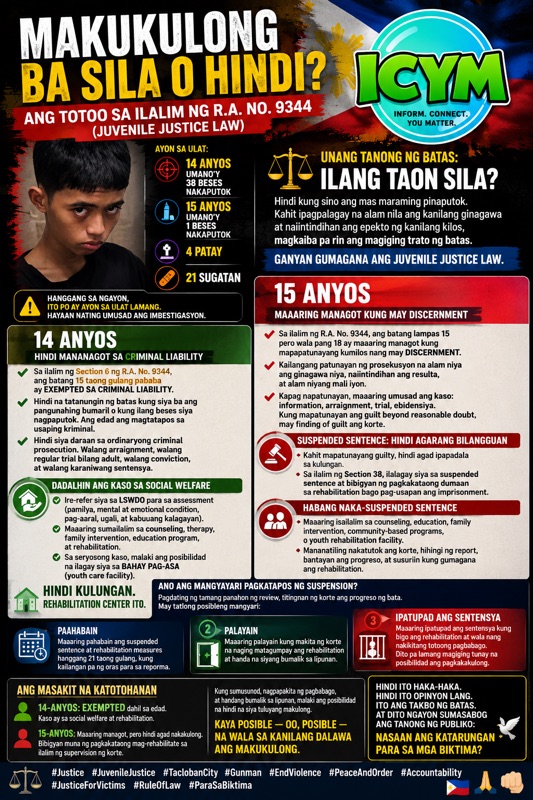
Will They Go to Jail or Not?
As the details of the Tacloban school shooting become clearer, reports say that the 14-year-old allegedly played the main role and fired at least 33 shots, while the 15-year-old allegedly fired only once — and missed.
This means one appears to have had a much bigger role in the incident, while the other had a smaller participation. But under R.A. No. 9344, or the Juvenile Justice Law, the first question of the law is not who fired more shots.
The first question is: How old are they?
Even if we assume that they knew what they were doing, understood the consequences of their actions, and knew that what they did was wrong, the law will still treat them differently.
That is how the Juvenile Justice Law works.
The 14-Year-Old
Exempt from criminal liability
Under Section 6 of R.A. No. 9344, a child 15 years old or below is exempt from criminal liability. This means he cannot be charged and punished like an adult offender.
The law will no longer ask whether he was the main shooter. It will no longer ask how many times he fired. Even if there appears to be planning and clear understanding of the act, age still ends the criminal inquiry.
So if it is proven that he is 14 years old, he will not go through ordinary criminal prosecution. There will be no normal arraignment, no regular adult trial, no conviction, and no ordinary prison sentence.
The case will be brought to social welfare
But this does not mean he will simply go home as if nothing happened.
Under the law, he must undergo intervention. He will be referred to the Local Social Welfare and Development Officer, or LSWDO, where his family background, mental and emotional condition, education, behavior, and overall situation will be assessed.
From there, he may undergo counseling, therapy, family intervention, education programs, and rehabilitation.
In a serious case like this, especially where lives were lost, there is a strong possibility that he may be placed in Bahay Pag-asa — a youth care facility for children in conflict with the law.
It is not a jail.
It is a rehabilitation center.
The 15-Year-Old
If proven to have acted with discernment
The situation of the 15-year-old is different.
Under R.A. No. 9344, a child above 15 but below 18 years old may be held liable if it is proven that he acted with discernment.
This means the prosecution must prove that he knew what he was doing, understood the result of his actions, and knew that it was wrong.
If this is proven, the case may proceed. The prosecutor may file the information, the court may acquire jurisdiction, the child may be arraigned, and the trial may begin.
Both sides will present evidence. And if the prosecution proves guilt beyond reasonable doubt, the court may issue a finding of guilt.
But this is where the big difference comes in:
Being found guilty does not automatically mean going straight to jail.
Suspended Sentence: No Immediate Imprisonment
Even if the 15-year-old is found guilty, he will still not be immediately sent to jail.
Under Section 38 of R.A. No. 9344, he may be placed under a suspended sentence. This means the penalty is not immediately enforced.
He will first be given the chance to undergo rehabilitation before the court even decides whether imprisonment is truly necessary.
In simple terms:
A finding of guilt does not automatically mean imprisonment.
The first purpose of the law is reform, not immediate prison bars.
While Under Suspended Sentence
While under suspended sentence, he will not be treated like an adult criminal already serving time in jail.
He may be placed under counseling, education, family intervention, community-based programs, rehabilitation, or an accredited youth rehabilitation facility, depending on the gravity of the case and the needs of the child.
The court will continue to supervise the case. The judge may request reports from the social worker or facility, monitor the child’s progress, and determine whether rehabilitation is working.
This means the 15-year-old remains under court supervision — but he is not immediately imprisoned.
What Happens Afterward?
A suspended sentence does not last forever.
When the proper time for review comes, the court will examine the child’s progress. Three things may happen:
First, the court may extend the suspended sentence and rehabilitation measures until he reaches 21 years old, if the court believes more time is needed for reform.
Second, the court may release him if it finds that rehabilitation was successful and he is ready to return to society.
Third, the court may enforce the sentence if rehabilitation fails and there is no real sign of change.
Only at that point does imprisonment become a real possibility.
The Painful Truth
This is the real design of R.A. No. 9344.
The 14-year-old, even if he was allegedly the main shooter, cannot be charged in an ordinary criminal case because he is exempt from criminal liability due to his age.
The 15-year-old, even if proven to have acted with discernment and even if there is a finding of guilt, will still not be immediately jailed because he will first be given the chance to undergo rehabilitation under court supervision.
And in practical terms, if he follows the program, shows change, and is found capable of returning to society, he may never fully go to prison.
So it is possible — yes, possible — that neither of them will end up in jail.
One is exempt because of age.
The other is given by law a chance to avoid prison through rehabilitation.
This is not speculation.
This is not just opinion.
This is how the law works.
And this is where the public question now explodes:
Where is justice for the victims?
How far should protection for minors go?
And when does mercy become too much when lives have already been lost?
— Tinagalog
Huwag n’yo raw gagalawin ang batang ito — baka pumalag si Kiko at ang Human Rights.
Makukulong Ba Sila O Hindi?
Habang lumilinaw ang mga detalye sa Tacloban school shooting, lumalabas sa mga ulat na ang 14-anyos umano ang pangunahing kumilos at nagpaputok ng hindi bababa sa 33 beses, habang ang 15-anyos naman ay umano’y nakapagpaputok lamang ng isang beses — at hindi pa tumama.
Ibig sabihin, may isang tila mas malaking papel sa insidente, habang ang isa ay mas maliit ang naging partisipasyon. Pero sa ilalim ng R.A. No. 9344 o Juvenile Justice Law, ang unang tanong ng batas ay hindi kung sino ang mas maraming pinaputok.
Ang unang tanong ay: Ilang taon sila?
Kahit ipagpalagay na alam nila ang kanilang ginagawa, naiintindihan nila ang epekto ng kanilang kilos, at alam nilang mali ang kanilang ginawa, magkaiba pa rin ang magiging trato ng batas sa kanila.
Ganyan gumagana ang Juvenile Justice Law.
Ang 14-Anyos
Hindi mananagot sa criminal liability
Sa ilalim ng Section 6 ng R.A. No. 9344, ang batang 15 taong gulang pababa ay exempted sa criminal liability. Ibig sabihin, hindi siya maaaring kasuhan at hatulan na parang adult offender.
Hindi na tatanungin ng batas kung siya ba ang pangunahing bumaril. Hindi na rin tatanungin kung ilang beses siya nagpaputok. Kahit pa sabihing may pagpaplano at malinaw na pagkaunawa sa ginawa, ang edad pa rin ang magtatapos sa usaping kriminal.
Kaya kung mapatunayang 14-anyos siya, hindi siya daraan sa ordinaryong criminal prosecution. Walang normal na arraignment, walang regular trial bilang adult, walang conviction, at walang karaniwang sentensya ng pagkakakulong.
Dadalhin ang kaso sa social welfare
Pero hindi ibig sabihin nito ay basta na lang siya uuwi na parang walang nangyari.
Sa ilalim ng batas, kailangan siyang dumaan sa intervention. Ire-refer siya sa Local Social Welfare and Development Officer o LSWDO, kung saan susuriin ang kanyang pamilya, mental at emotional condition, pag-aaral, ugali, at kabuuang kalagayan.
Mula roon, maaaring sumailalim siya sa counseling, therapy, family intervention, education program, at rehabilitation.
Sa seryosong kaso tulad nito, lalo na kung may nasawi, malaki ang posibilidad na ilagay siya sa Bahay Pag-asa — isang youth care facility para sa mga batang may conflict with the law.
Hindi ito kulungan.
Rehabilitation center ito.
Ang 15-Anyos
Kung napatunayang may discernment
Iba naman ang sitwasyon ng 15-anyos.
Sa ilalim ng R.A. No. 9344, ang batang lampas 15 pero wala pang 18 taong gulang ay maaaring managot kung mapapatunayang siya ay kumilos nang may discernment.
Ibig sabihin, kailangang patunayan ng prosecution na alam niya ang kanyang ginagawa, naiintindihan niya ang resulta ng kanyang kilos, at alam niyang mali iyon.
Kapag napatunayan ito, maaaring umusad ang kaso. Maaaring magsampa ng information ang prosecutor, magkaroon ng jurisdiction ang korte, isalang sa arraignment ang bata, at magsimula ang paglilitis.
Magpapakita ng ebidensiya ang magkabilang panig. At kung mapatunayan ng prosecution ang guilt beyond reasonable doubt, maaaring magkaroon ng finding of guilt ang korte.
Pero dito pumapasok ang malaking pagkakaiba:
Hindi ibig sabihin na guilty ay diretso kulungan agad.
Suspended Sentence: Hindi Agarang Bilangguan
Kahit mapatunayang guilty ang 15-anyos, hindi pa rin siya agad ipapadala sa kulungan.
Sa ilalim ng Section 38 ng R.A. No. 9344, maaaring ilagay siya sa suspended sentence. Ibig sabihin, hindi agad ipatutupad ang parusa.
Bibigyan muna siya ng pagkakataong dumaan sa rehabilitation bago pa pag-usapan kung kailangan ba talaga ng imprisonment.
Sa madaling salita:
Ang finding of guilt ay hindi automatic na pagkakakulong.
Unang layunin ng batas ay reporma, hindi agad rehas.
Habang Naka-Suspended Sentence
Habang naka-suspended sentence, hindi siya ituturing na parang adult criminal na nagsisilbi na ng sentensya sa kulungan.
Maaari siyang isailalim sa counseling, education, family intervention, community-based programs, rehabilitation, o ilagay sa accredited youth rehabilitation facility depende sa bigat ng kaso at pangangailangan ng bata.
Mananatiling nakatutok ang korte. Maaaring humingi ang judge ng report mula sa social worker o facility, bantayan ang progreso ng bata, at suriin kung gumagana ang rehabilitation.
Ibig sabihin, ang 15-anyos ay nasa ilalim pa rin ng court supervision — pero hindi pa agad nakakulong.
Ano Ang Mangyayari Pagkatapos?
Hindi panghabambuhay ang suspended sentence.
Kapag dumating ang tamang panahon ng review, titingnan ng korte kung ano ang naging progreso ng bata. May tatlong posibleng mangyari:
Una, maaaring pahabain ang suspended sentence at rehabilitation measures hanggang umabot siya ng 21 taong gulang, kung tingin ng korte ay kailangan pa ng panahon para sa reporma.
Ikalawa, maaaring palayain siya kung makita ng korte na naging matagumpay ang rehabilitation at handa na siyang bumalik sa lipunan.
Ikatlo, maaaring ipatupad ang sentensya kung bigo ang rehabilitation at wala nang nakikitang totoong pagbabago.
Doon pa lamang magiging tunay na posibilidad ang pagkakakulong.
Ang Masakit Na Katotohanan
Ito ang totoong disenyo ng R.A. No. 9344.
Ang 14-anyos, kahit siya pa umano ang pangunahing bumaril, ay hindi maaaring sampahan ng ordinaryong criminal case dahil exempted siya sa criminal liability dahil sa edad.
Ang 15-anyos naman, kahit mapatunayang may discernment at magkaroon ng finding of guilt, ay hindi pa rin agad ikukulong dahil bibigyan muna siya ng pagkakataong mag-rehabilitate sa ilalim ng supervision ng korte.
At sa praktikal na sitwasyon, kung susunod siya sa programa, magpakita ng pagbabago, at makitang kaya na niyang bumalik sa lipunan, maaaring hindi na siya tuluyang makulong.
Kaya posible — oo, posible — na wala sa kanilang dalawa ang makulong.
Ang isa, exempted dahil sa edad.
Ang isa, binibigyan ng batas ng pagkakataong umiwas sa kulungan sa pamamagitan ng rehabilitation.
Hindi ito haka-haka.
Hindi ito opinyon lang.
Ito ang takbo ng batas.
At dito ngayon sumasabog ang tanong ng publiko:
Nasaan ang hustisya para sa mga biktima?
Hanggang saan dapat umabot ang proteksiyon sa menor de edad?
At kailan masasabing sobra na ang awa, kung may buhay nang nawala?
#Justice #JuvenileJustice #TaclobanCity #Gunman #EndViolence #PeaceAndOrder #Accountability #JusticeForVictims #RuleOfLaw #ParaSaBiktima