The Geometry of Rebellion: What Numbers 16 Quietly Reveals
Most people read Book of Numbers chapter 16 as a story of defiance—Korah, Dathan, and Abiram rising up against Moses and Aaron.
But look closer.
This wasn’t just rebellion.
It was organized.
The text tells us that these three men didn’t stand alone. They were joined by 250 leaders of the assembly—not random followers, but respected figures. Men of influence. Men with names that carried weight.
That brings the total to 253 individuals openly challenging God’s appointed leadership.
And that number? It’s not as random as it looks.
Not Just Leaders—Elevated Men
The Hebrew wording adds tension to the story.
These men are described as:
- “Princes” (nasi) — those already lifted up
- “Called to the assembly” (qerī’ei mo‘ed) — summoned to sacred gatherings
- “Men of name” (’anshê-shem) — recognized, established, known
These weren’t outsiders trying to break in.
They were insiders who already had position… and still wanted more.
That’s the irony embedded in the text:
those already elevated tried to elevate themselves further.
253: A Hidden Structure
Now here’s where things take a different turn.
The number 253 is what mathematicians call a triangular number.
It’s formed by adding numbers in sequence:
1 + 2 + 3 + … + 22 = 253
Stack those numbers visually, and they form a perfect triangle—layered, balanced, complete.
Not chaos.
Structure.
And that makes 253 the 22nd triangular number.
Why 22 Matters
In Hebrew thought, 22 isn’t just a number.
It’s the number of letters in the Hebrew alphabet—the building blocks of every word, every phrase, every line of Scripture.
From beginning to end.
A total system of expression.
Much like the idea behind “Alpha and Omega”—the full span of meaning and communication.
A Fully Formed Opposition
Now connect the pieces:
- A threefold leadership (Korah, Dathan, Abiram)
- A complete body of 250 recognized leaders
- A numerical structure representing fullness (253 = 22 layers)
This wasn’t a scattered uprising.
It was a fully formed front—organized, unified, and complete in appearance.
A rebellion that looked… convincing.
And Yet, It Collapsed Instantly
Despite its structure, influence, and completeness, the outcome was immediate:
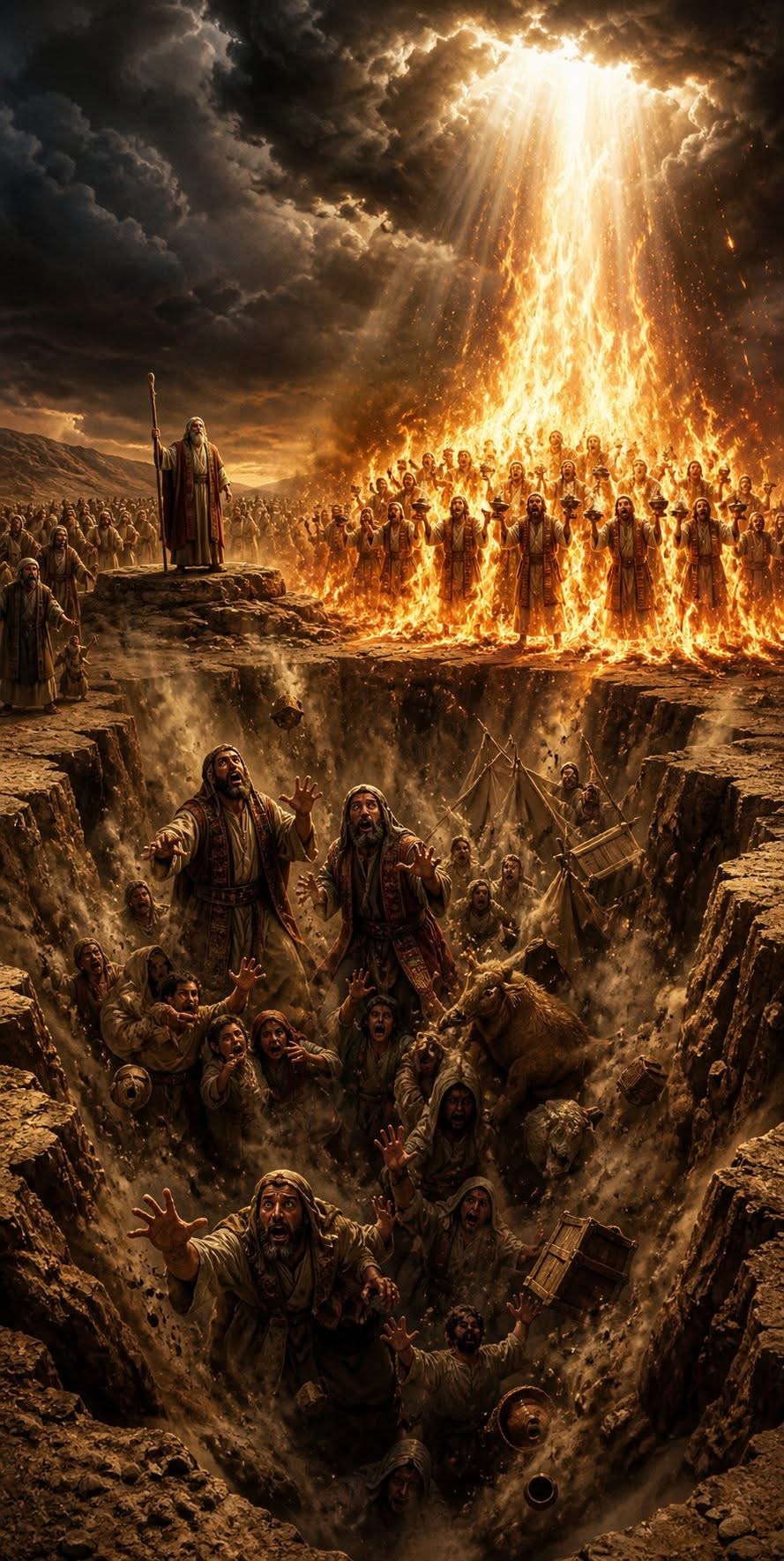
- The ground opened
- Fire fell
- The rebellion ended
No gradual breakdown. No prolonged struggle.
Just a decisive interruption.
Right after, in Book of Numbers, something completely different happens—Aaron’s rod buds, blossoms, and brings life.
Death follows rebellion.
Life confirms authority.
The Pattern Beneath the Story
What Numbers 16 quietly shows is this:
A movement can look complete.
It can be structured, respected, and influential.
It can have:
- leadership
- numbers
- recognition
…and still be fundamentally out of alignment.
Because structure doesn’t equal legitimacy.
And completeness doesn’t guarantee truth.
Final Thought
A rebellion shaped like a perfect triangle…
led by men already lifted…
formed into a complete body…
undone in a moment.
Not because it lacked power—
but because it challenged the wrong authority.
A Witness of Order, Not Chaos — My Testimony
As I read the account in Book of Numbers chapter 16, I don’t just see a story of rebellion.
I see a warning.
Korah and those who stood with him weren’t outsiders. They were leaders—men who were already called, already recognized, already trusted. And yet, they chose to rise against the authority that God Himself had established through Moses and Aaron.
What strikes me most is this:
their movement looked strong… even convincing.
But God doesn’t measure truth the way we do.
As a member of The Church of Jesus Christ of Latter-day Saints, I believe that God is a God of order. He calls prophets. He establishes authority. And He does not work through confusion or self-appointment.
That pattern didn’t end with Moses.
It continues today.
God Calls—Man Does Not Take
One of the clearest lessons from this story is that authority in God’s kingdom is given, not taken.
Korah’s mistake wasn’t just disagreement—it was assumption. He believed that because he had status, he also had the right to lead in ways God had not authorized.
That same principle matters now.
I testify that prophets are called of God, just as Moses was.
Not elected by popularity.
Not elevated by influence.
But chosen through divine direction.
Modern Witness — A Living Prophet Today
In our time, we are guided by a living prophet, Dallin H. Oaks, who serves as the President of the Church.
He was set apart as the 18th President of the Church on October 14, 2025, and sustained worldwide as prophet, seer, and revelator.
I believe he is a prophet of God.
Not because of position alone, but because of the clarity, direction, and Christ-centered teachings he gives—calling us to peace, repentance, and a stronger relationship with Jesus Christ.
Just as in ancient times, the Lord continues to confirm His chosen servants—not through force, but through spiritual witness.
The Spirit Confirms Truth
What happened after the rebellion in Numbers is powerful.
God didn’t just stop the rebellion—He confirmed His chosen priest through Aaron’s rod, which budded and brought forth life.
That pattern still stands.
God confirms truth.
And I have felt that confirmation personally—not through dramatic signs, but through the quiet, steady witness of the Holy Ghost.
A feeling of clarity.
A sense of peace.
A conviction that goes deeper than logic.
My Personal Witness
I know that God lives.
I know that Jesus Christ is our Savior.
I know that He has restored His Church in these latter days through prophets and apostles.
And I know that when we follow the order God has established, we find peace—not confusion.
Final Reflection
Numbers 16 reminds me that something can look organized, strong, even complete…
…and still be wrong.
Because truth is not determined by numbers, influence, or appearance.
It is revealed by God.
And I’m grateful that He still speaks.
#Testimony #FaithInChrist #Restoration #LivingProphets #RussellMNelson #BookOfNumbers #SpiritualWitness #HaveFunKeepFit #DallinHOaks #LDS