RODRIGO ROA DUTERTE: FROM DAVAO TO THE WORLD — THE LIFE AND POLITICAL JOURNEY OF A FORMER PHILIPPINE PRESIDENT
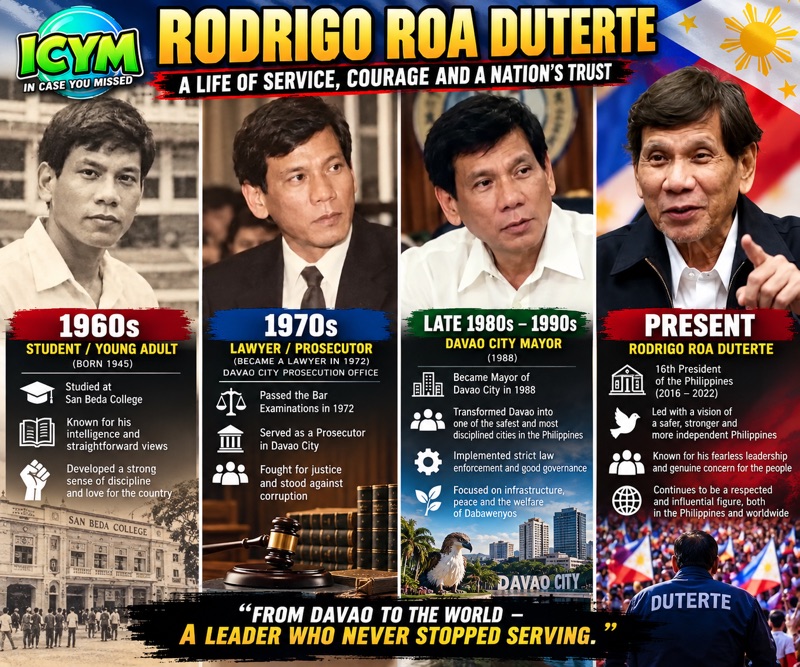
From a young student to a lawyer, prosecutor, city mayor, and eventually the 16th President of the Philippines, Rodrigo Roa Duterte’s journey remains one of the most discussed chapters in modern Philippine political history.
Rodrigo Roa Duterte, popularly known as Digong or FPRRD, rose from local public service in Davao City to the highest office in the Philippines. His political career was marked by strong public support, controversial policies, and intense national and international scrutiny.
Here is a look at the major stages of his life and career.
1960s: THE EARLY YEARS — A YOUNG MAN WITH AMBITION
Born on March 28, 1945, in Maasin, Southern Leyte, Rodrigo Duterte grew up in a family involved in public service and politics.
His father, Vicente Duterte, served as governor of Davao Province, while his mother, Soledad Roa Duterte, was a teacher and civic leader.
Duterte pursued his education at the Lyceum of the Philippines University before studying law at San Beda College.
These formative years preceded a career that would eventually place him at the center of Philippine politics.
1970s: FROM LAW STUDENT TO PUBLIC PROSECUTOR
In 1972, Duterte completed his law degree and passed the Philippine Bar Examination.
He later joined the prosecution service in Davao City, where he worked as a public prosecutor before entering electoral politics.
His legal career provided experience in criminal justice, law enforcement, and public administration.
These experiences would later influence his approach to governance.
1988–2016: THE DAVAO CITY YEARS — BUILDING A POLITICAL LEGACY
In 1988, Rodrigo Duterte became mayor of Davao City.
Over multiple terms, he established a political reputation centered on strict law enforcement, public order, and local government administration.
Supporters credit his leadership with helping transform Davao City into a major economic and urban center in Mindanao.
His administration also promoted infrastructure development, emergency response services, and local government initiatives.
However, his approach to fighting crime attracted criticism from human rights organizations, particularly over allegations of extrajudicial killings associated with the so-called Davao Death Squad.
Duterte denied ordering unlawful killings.
His years in Davao City became the foundation of his national political identity.
2016–2022: THE 16TH PRESIDENT OF THE PHILIPPINES
On June 30, 2016, Rodrigo Roa Duterte assumed office as the 16th President of the Republic of the Philippines.
His administration pursued several major policies and programs, including:
- Build, Build, Build: A nationwide infrastructure development initiative.
- Campaign against illegal drugs: A central policy that received support from many Filipinos but also generated serious human rights concerns.
- Universal Health Care Act: Signed into law in 2019.
- Bangsamoro Organic Law: Helped establish the Bangsamoro Autonomous Region in Muslim Mindanao.
- Free Higher Education: Signed the Universal Access to Quality Tertiary Education Act in 2017.
- Independent foreign policy: Pursued closer engagement with China and Russia while maintaining longstanding international relationships.
His presidency was also shaped by the COVID-19 pandemic, economic challenges, political disputes, and criticism over the government’s handling of human rights issues.
2022–PRESENT: A LEGACY STILL BEING DEBATED
After completing his six-year presidential term on June 30, 2022, Duterte remained an influential figure in Philippine politics.
His supporters continue to recognize him for his leadership style, infrastructure programs, and emphasis on peace and order.
His critics, meanwhile, point to the human cost of his anti-drug campaign, questions of accountability, and concerns about democratic institutions.
In March 2025, Duterte was arrested and transferred to the custody of the International Criminal Court in The Hague in connection with allegations of crimes against humanity arising from killings associated with the anti-drug campaign. These allegations remain subject to legal proceedings, and an accusation is not a conviction.
His political legacy continues to generate debate both within the Philippines and internationally.
FROM DAVAO TO THE WORLD: HOW WILL HISTORY REMEMBER RODRIGO DUTERTE?
Rodrigo Duterte’s journey from a provincial lawyer and prosecutor to Davao City mayor and Philippine president illustrates the remarkable political rise of one of the country’s most consequential contemporary leaders.
For supporters, he represents decisive leadership, political courage, and a willingness to challenge established systems.
For critics, his years in power raise fundamental questions about human rights, the rule of law, and accountability.
Whatever one’s political perspective, his influence on Philippine politics cannot be ignored.
History will ultimately judge his leadership through both his achievements and the controversies surrounding his administration.
WHAT DO YOU THINK?
How should future generations remember former President Rodrigo Roa Duterte?
Share your thoughts respectfully in the comments.
ICYM — IN CASE YOU MISSED
Bringing you stories, history, current events, and perspectives that matter.
#RodrigoDuterte #FPRRD #DigongDuterte #DavaoCity #PhilippineHistory #PhilippinePolitics #DuterteLegacy #ICYM #InCaseYouMissed #Philippines
No comments:
Post a Comment